The full texts of the classic Christian prayers, from the Lord’s Prayer to the Jesus Prayer, the Angelus and Luther’s evening prayer, with where each comes from and who prays it
Christians have always prayed in their own words, and they have always prayed in words they were given. When the disciples asked Jesus to teach them to pray, he gave them a prayer to say (Luke 11:1-4). Ever since, churches have handed on short prayers for morning and night, for meals, for the sick and the dying, and for the moments when people cannot find words of their own.
This page collects the classic prayers that Christians of different traditions know by heart, with the full text of each, a note on where it comes from, and who prays it today. Some are shared by nearly every church. Others belong to one family of churches, and the page says so plainly, so that a Catholic, an Orthodox Christian, an Anglican and a Baptist can each find their own prayers here and understand their neighbors’.
Every text was checked word for word against a published source, named under each prayer.
Why pray with written prayers?
And he said to them, “When you pray, say: “Father, hallowed be your name. Your kingdom come.
Luke 11:2 (ESV)
A written prayer is not a substitute for talking to God in your own words. It is a way of being taught. Old prayers give words to people who are grieving, frightened or worn out, and they teach a shape for prayer: praise first, then confession, thanks and asking. They also join you to everyone else who has said the same words, in your own church and across the centuries.
- Praise
- Begin with who God is“Hallowed be thy name”
- Confession
- Say what is wrong“Forgive us our trespasses”
- Thanks
- Name what you have been givenThe General Thanksgiving
- Asking
- For yourself and for others“Give us this day our daily bread”
Jesus warned against “empty phrases” said to be heard by many words (Matthew 6:7). Christians who love set prayers and Christians who avoid them both take that warning seriously. The difference between them is mostly about how to keep prayer from becoming empty, not about whether prayer should come from the heart. There is more on this below.
All 26 prayers at a glanceJump to any prayer
| Prayer | Tradition | When it is prayed | Length |
|---|---|---|---|
| The Lord’s Prayer (Our Father) | Shared by nearly all Christians | Every service; daily | 71 words |
| Glory Be (the Gloria Patri) | Shared by nearly all Christians | After psalms; the Rosary | 30 words |
| The Doxology (“Praise God, from whom all blessings flow”) | Shared by nearly all Christians | Sunday worship; the offering | 26 words |
| The Jesus Prayer | From the Christian East | Throughout the day | 12 words |
| The Trisagion (Thrice-Holy) | From the Christian East | Daily prayers; the Liturgy | 10 words |
| The Hail Mary | Catholic devotions | Daily; the Rosary | 42 words |
| The Angelus | Catholic devotions | 6 a.m., noon, 6 p.m. | 128 words |
| The Memorare | Catholic devotions | In need | 73 words |
| Hail, Holy Queen (Salve Regina) | Catholic devotions | Night; end of the Rosary | 72 words |
| Soul of Christ (Anima Christi) | Catholic devotions | After Communion | 85 words |
| Prayer to St. Michael the Archangel | Catholic devotions | In temptation; after Mass | 59 words |
| Prayer to the Guardian Angel | Catholic devotions | Morning; children | 29 words |
| An Act of Contrition | Catholic devotions | Confession; night | 69 words |
| Grace before meals (“Bless us, O Lord”) | Catholic devotions | Before meals | 22 words |
| Eternal Rest (for the departed) | Catholic devotions | For the departed | 20 words |
| The Collect for Purity | From the Book of Common Prayer | Start of worship | 48 words |
| The General Thanksgiving | From the Book of Common Prayer | Morning and Evening Prayer | 151 words |
| O Gracious Light (Phos Hilaron) | From the Book of Common Prayer | Evening | 73 words |
| Keep watch, dear Lord (a prayer at night) | From the Book of Common Prayer | Night | 52 words |
| Guide us waking (the Compline antiphon) | From the Book of Common Prayer | Night | 23 words |
| Luther’s Morning Prayer | Lutheran and Protestant | On rising | 80 words |
| Luther’s Evening Prayer | Lutheran and Protestant | At bedtime | 73 words |
| Come, Lord Jesus (a table prayer) | Lutheran and Protestant | Before meals | 12 words |
| Now I lay me down to sleep | Lutheran and Protestant | Children at bedtime | 30 words |
| St. Patrick’s Breastplate (from the Lorica) | Medieval and Celtic | Morning; protection | 68 words |
| The Prayer of St. Richard of Chichester | Medieval and Celtic | Any time | 48 words |
Prayers shared by nearly all Christians
These three are prayed, in nearly the same words, by Catholic, Orthodox, Anglican, Lutheran, Reformed, Methodist, Baptist and many other Christians.
The Lord’s Prayer (Our Father)Shared by nearly all Christians
- Our Father, who art in heaven,
- hallowed be thy Name,
- thy kingdom come,
- thy will be done,
- on earth as it is in heaven.
- Give us this day our daily bread.
- And forgive us our trespasses,
- as we forgive those who trespass against us.
- And lead us not into temptation,
- but deliver us from evil.
- For thine is the kingdom, and the power, and the glory,
- for ever and ever. Amen.
The prayer Jesus taught his disciples (Matthew 6:9-13; Luke 11:2-4), prayed by every Christian tradition. The closing doxology (“For thine is the kingdom…”) is found in some ancient manuscripts of Matthew and in the Didache. Catholics say the prayer without it in private and add a related acclamation at Mass; Orthodox priests say the doxology after the people pray; most Protestants and Anglicans include it. Some churches say “debts” and “debtors” (Matthew’s word) instead of “trespasses.”
Text: The Book of Common Prayer (Episcopal Church, 1979), public domain.
Glory Be (the Gloria Patri)Shared by nearly all Christians
- Glory be to the Father and to the Son and to the Holy Spirit,
- as it was in the beginning is now,
- and ever shall be world without end. Amen.
A short hymn of praise to the Trinity from the early centuries, said at the end of psalms in Catholic, Orthodox, Anglican and Lutheran worship and in the Rosary. Older English has “Holy Ghost.”
Text: Compendium of the Catechism of the Catholic Church (2005), Appendix A: Common Prayers.
The Doxology (“Praise God, from whom all blessings flow”)Shared by nearly all Christians
- Praise God, from whom all blessings flow;
- Praise Him, all creatures here below;
- Praise Him above, ye heavenly host;
- Praise Father, Son, and Holy Ghost. Amen.
Written by the Anglican bishop Thomas Ken in 1674 as the last verse of his morning and evening hymns, and sung every Sunday in many Protestant churches, often when the offering is brought forward.
Text: Thomas Ken (1674), public domain.
For a full guide to praying the Lord’s Prayer line by line, and eight other ways to pray, see our guide to how to pray.
Prayers from the Christian East

The Orthodox churches have kept a tradition of short prayers repeated slowly, so that prayer can go on through the day “without ceasing” (1 Thessalonians 5:17). The Jesus Prayer, in particular, has been taken up by Christians of many traditions.
The Jesus PrayerFrom the Christian East
- Lord Jesus Christ, Son of God, have mercy on me, a sinner.
The prayer of the heart of the Orthodox tradition, repeated slowly and often, sometimes with a prayer rope. It joins the blind man’s cry (Mark 10:47) to the tax collector’s (Luke 18:13). Many Catholics and Protestants now pray it too.
Text: The Divine Liturgy and the Hours, common English form.
The Trisagion (Thrice-Holy)From the Christian East
- Holy God, Holy Mighty, Holy Immortal, have mercy on us.
Sung in every Orthodox Divine Liturgy and said three times at the start of daily prayers. It is also used on Good Friday in the Catholic liturgy and in some Anglican and Lutheran services.
Text: The Divine Liturgy and the Hours, common English form.
Catholic prayers and devotions
These prayers belong to the Catholic tradition, and many of them to the Christian West as a whole before the Reformation. Several ask the prayers of Mary, the angels or the saints. Catholic and Orthodox Christians understand this the way one believer asks another to pray for them, and are clear that worship belongs to God alone. Most Protestants do not pray this way, for reasons explained below. The texts are given in the traditional form printed in the Compendium of the Catechism of the Catholic Church (2005) or the Baltimore Catechism.
The Hail MaryCatholic devotions
- Hail, Mary, full of grace, the Lord is with thee.
- Blessed art thou among women,
- and blessed is the fruit of thy womb, Jesus.
- Holy Mary, Mother of God,
- pray for us sinners, now and at the hour of our death. Amen.
The first half joins the angel’s greeting (Luke 1:28) to Elizabeth’s (Luke 1:42). The second half, asking Mary’s prayers, was added in the late Middle Ages and fixed in 1568. The Orthodox say a related greeting, “Rejoice, O Virgin Theotokos.” Most Protestants do not ask the prayers of the saints; see below.
Text: Compendium of the Catechism of the Catholic Church (2005), Appendix A: Common Prayers.
The AngelusCatholic devotions
- V.The Angel of the Lord declared unto Mary.
- R.And she conceived of the Holy Spirit.
- Hail Mary…
- V.Behold the handmaid of the Lord.
- R.Be it done unto me according to thy word.
- Hail Mary…
- V.And the Word was made flesh.
- R.And dwelt among us.
- Hail Mary…
- V.Pray for us, O holy Mother of God.
- R.That we may be made worthy of the promises of Christ.
- Let us pray; Pour forth, we beseech thee, O Lord, thy grace into our hearts; that we, to whom the Incarnation of Christ, thy Son, was made known by the message of an angel, may by his Passion and Cross be brought to the glory of his Resurrection. Through the same Christ, our Lord. Amen.
A short devotion recalling the Incarnation, traditionally prayed at 6 a.m., noon and 6 p.m. when church bells ring. “V.” is said by a leader and “R.” by everyone. In the Easter season Catholics say the Regina Caeli instead.
Text: Compendium of the Catechism of the Catholic Church (2005), Appendix A: Common Prayers.
The MemorareCatholic devotions
- Remember, O most gracious Virgin Mary, that never was it known that anyone who fled to thy protection, implored thy help, or sought thy intercession, was left unaided.
- Inspired by this confidence I fly unto thee, O Virgin of virgins, my Mother.
- To thee do I come, before thee I stand, sinful and sorrowful.
- O Mother of the Word Incarnate, despise not my petitions, but in thy mercy hear and answer me. Amen.
A medieval prayer, made popular in the 17th century by the French priest Claude Bernard. Its name is its first word in Latin, “Remember.”
Text: Compendium of the Catechism of the Catholic Church (2005), Appendix A: Common Prayers.
Hail, Holy Queen (Salve Regina)Catholic devotions
- Hail, Holy Queen, Mother of Mercy, our life, our sweetness and our hope.
- To you do we cry, poor banished children of Eve.
- To you do we send up our sighs, mourning and weeping in this valley of tears
- Turn then, most gracious advocate, your eyes of mercy toward us,
- and after this exile show unto us the blessed fruit of thy womb, Jesus.
- O clement, O loving, O sweet Virgin Mary.
An 11th-century Latin antiphon, sung at the close of night prayer and said at the end of the Rosary. This is the form most used in the United States.
Text: Compendium of the Catechism of the Catholic Church (2005), Appendix A: Common Prayers.
Soul of Christ (Anima Christi)Catholic devotions
- Soul of Christ, be my sanctification.
- Body of Christ, be my salvation.
- Blood of Christ, fill all my veins.
- Water of Christ’s side, wash out my stains.
- Passion of Christ, my comfort be.
- O good Jesus, listen to me.
- In Thy wounds I fain would hide,
- N’er to be parted from Thy side,
- Guard me, should the foe assail me.
- Call me when my life shall fail me.
- Bid me come to Thee above,
- With Thy saints to sing Thy love,
- World without end. Amen.
A 14th-century prayer, often said after Communion, which St. Ignatius of Loyola placed at the start of his Spiritual Exercises.
Text: Compendium of the Catechism of the Catholic Church (2005), Appendix A: Common Prayers.
Prayer to St. Michael the ArchangelCatholic devotions
- Saint Michael the Archangel, defend us in battle.
- Be our protection against the wickedness and snares of the devil;
- May God rebuke him, we humbly pray;
- And do thou, O Prince of the Heavenly Host, by the power of God, thrust into hell Satan and all evil spirits who wander through the world for the ruin of souls. Amen.
Composed by Pope Leo XIII in 1886 and said after Low Mass until 1964. Pope John Paul II asked Catholics to keep praying it (1994). Michael appears in Daniel 10, Jude 9 and Revelation 12.
Text: Prayer of Pope Leo XIII (1886), English as printed by the Holy See (1994).
Prayer to the Guardian AngelCatholic devotions
- Angel of God, my guardian dear,
- to whom God’s love commits me here,
- ever this day be at my side,
- to light and guard, to rule and guide. Amen.
A children’s prayer from the Middle Ages, drawing on Matthew 18:10 and Psalm 91:11.
Text: Compendium of the Catechism of the Catholic Church (2005), Appendix A: Common Prayers.
An Act of ContritionCatholic devotions
- O my God! I am heartily sorry for having offended Thee, and I detest all my sins, because I dread the loss of heaven and the pains of hell, but most of all because they offend Thee, my God, who art all-good and deserving of all my love.
- I firmly resolve, with the help of Thy grace, to confess my sins, to do penance, and to amend my life.
Said in the sacrament of confession and at night. This is the traditional American text; there are several approved versions.
Text: A Catechism of Christian Doctrine No. 1 (the Baltimore Catechism, 1885 text), public domain.
Grace before meals (“Bless us, O Lord”)Catholic devotions
- Bless us, O Lord! and these Thy gifts, which we are about to receive from Thy bounty, through Christ our Lord. Amen.
The most familiar Catholic table grace in English.
Text: A Catechism of Christian Doctrine No. 1 (the Baltimore Catechism, 1885 text), public domain.
Eternal Rest (for the departed)Catholic devotions
- Eternal rest grant unto them, O Lord, and let perpetual light shine upon them. May they rest in peace. Amen.
From the Latin Requiem. Catholic, Orthodox and many Anglican Christians pray for the departed; most Protestants do not, holding that the dead are already in God’s hands.
Text: Compendium of the Catechism of the Catholic Church (2005), Appendix A: Common Prayers.
How to pray the Rosary
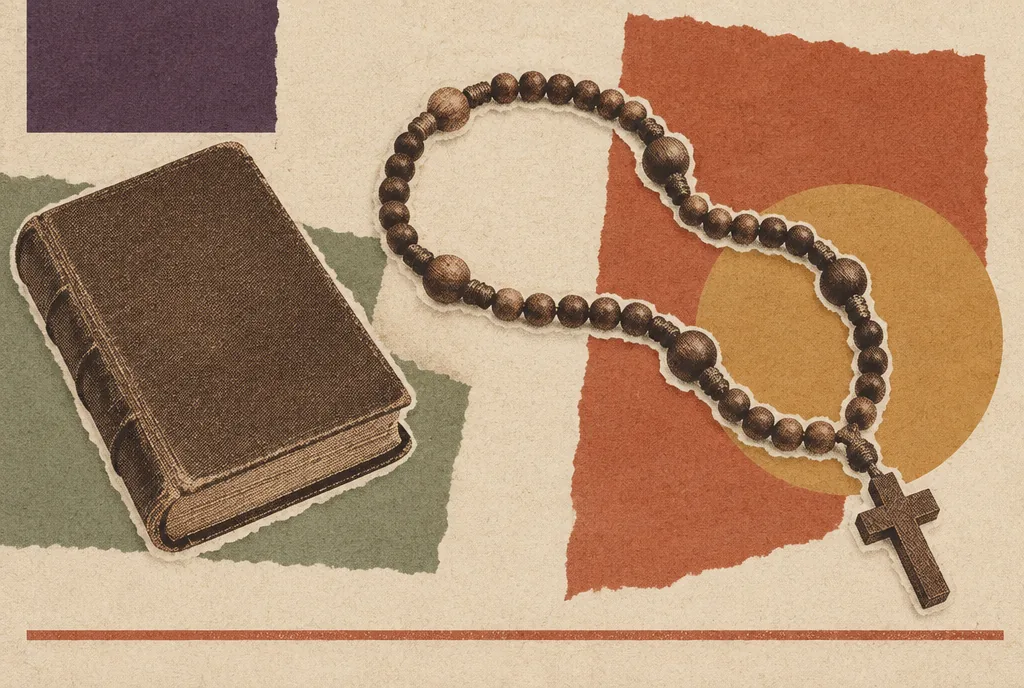
The Rosary is a Catholic prayer that walks through the life of Jesus with Mary. While the lips repeat familiar prayers, the mind dwells on one event, or “mystery,” at a time: from the angel’s visit to Mary, through Jesus’ ministry and death, to the resurrection. It grew up in the Middle Ages as a way for people who could not read the 150 psalms to pray 150 Hail Marys instead. In 2002 Pope John Paul II added five Luminous Mysteries from Jesus’ public ministry. Anglicans and Lutherans who use prayer beads usually pray other words on them.
- BeginMake the sign of the cross and say the Apostles’ Creed, holding the crucifix.
- First beadSay the Our Father.
- Next three beadsSay a Hail Mary on each, traditionally for faith, hope and love.
- ThenSay the Glory Be.
- Each decadeAnnounce the mystery and think about it. Say the Our Father on the large bead, a Hail Mary on each of the ten small beads, then the Glory Be. Many add the Fatima prayer, “O my Jesus, forgive us our sins…”
- Five decadesRepeat for the five mysteries of the day.
- CloseSay the Hail, Holy Queen and the closing prayer, and make the sign of the cross.
The Joyful Mysteries
Monday and Saturday
- The Annunciation
- The Visitation
- The Nativity
- The Presentation
- The Finding in the Temple
Read: Luke 1:26-38 · 1:39-56 · 2:1-20 · 2:22-38 · 2:41-52
The Luminous (Mysteries of Light) Mysteries
Thursday
- The Baptism of Jesus
- The Wedding Feast of Cana
- The Proclamation of the Kingdom, with the call to Conversion
- The Transfiguration
- The Institution of the Eucharist
Read: Matthew 3:13-17 · John 2:1-11 · Mark 1:14-15 · Luke 9:28-36 · Luke 22:14-20
The Sorrowful Mysteries
Tuesday and Friday
- The Agony in the Garden
- The Scourging at the Pillar
- The Crowning with Thorns
- The Carrying of the Cross
- The Crucifixion
Read: Mark 14:32-42 · 15:15 · 15:16-20 · John 19:17 · Luke 23:33-46
The Glorious Mysteries
Wednesday and Sunday
- The Resurrection
- The Ascension
- The Descent of the Holy Spirit
- The Assumption
- The Coronation of Mary Queen of Heaven and Earth
Read: Mark 16:1-8 · Acts 1:6-11 · Acts 2:1-13 · Church tradition · Revelation 12:1 (as read by Catholic tradition)
Closing prayerCompendium of the Catechism (2005)
O God, whose only-begotten Son, by his life, death and resurrection, has purchased for us the rewards of eternal life, grant, we beseech thee, that meditating on these mysteries of the most holy Rosary of the Blessed Virgin Mary, we may imitate what they contain and obtain what they promise, through the same Christ our Lord. Amen.
Days follow the Compendium of the Catechism; many people keep the Joyful Mysteries on Sundays in Advent and the Sorrowful on Sundays in Lent. Prayers used: Apostles’ Creed · Our Father · Hail Mary · Glory Be · Hail, Holy Queen.
The Apostles’ Creed is printed in full, with its history, in our guide to the Christian creeds.
Prayers from the Book of Common Prayer
The Book of Common Prayer, first published in 1549 by Thomas Cranmer, gave the English-speaking world many of its best-loved prayers. Anglicans and Episcopalians use it every day; Methodists, Presbyterians and Lutherans have borrowed from it freely. These texts follow the traditional-language services of the Episcopal Church’s 1979 prayer book.
The Collect for PurityFrom the Book of Common Prayer
- Almighty God, unto whom all hearts are open, all desires known, and from whom no secrets are hid: Cleanse the thoughts of our hearts by the inspiration of thy Holy Spirit, that we may perfectly love thee, and worthily magnify thy holy Name; through Christ our Lord. Amen.
A medieval Latin prayer that Thomas Cranmer placed at the start of the Communion service in 1549. Anglicans and Methodists still open the Lord’s Supper with it, and many Lutheran services use it too.
Text: The Book of Common Prayer (Episcopal Church, 1979), public domain.
The General ThanksgivingFrom the Book of Common Prayer
- Almighty God, Father of all mercies,
- we thine unworthy servants
- do give thee most humble and hearty thanks
- for all thy goodness and loving-kindness
- to us and to all men.
- We bless thee for our creation, preservation,
- and all the blessings of this life;
- but above all for thine inestimable love
- in the redemption of the world by our Lord Jesus Christ,
- for the means of grace, and for the hope of glory.
- And, we beseech thee,
- give us that due sense of all thy mercies,
- that our hearts may be unfeignedly thankful;
- and that we show forth thy praise,
- not only with our lips, but in our lives,
- by giving up our selves to thy service,
- and by walking before thee
- in holiness and righteousness all our days;
- through Jesus Christ our Lord,
- to whom, with thee and the Holy Ghost,
- be all honor and glory, world without end. Amen.
Written by Bishop Edward Reynolds for the 1662 Book of Common Prayer; prayed at Morning and Evening Prayer.
Text: The Book of Common Prayer (Episcopal Church, 1979), public domain.
O Gracious Light (Phos Hilaron)From the Book of Common Prayer
- O gracious Light,
- pure brightness of the everliving Father in heaven,
- O Jesus Christ, holy and blessed!
- Now as we come to the setting of the sun,
- and our eyes behold the vesper light,
- we sing thy praises, O God: Father, Son, and Holy Spirit.
- Thou art worthy at all times to be praised by happy voices,
- O Son of God, O Giver of life,
- and to be glorified through all the worlds.
One of the oldest Christian hymns outside the Bible, sung at the lighting of lamps by the 3rd or 4th century. The Orthodox sing it at every Vespers; this translation is from the Book of Common Prayer.
Text: The Book of Common Prayer (Episcopal Church, 1979), public domain.
Keep watch, dear Lord (a prayer at night)From the Book of Common Prayer
- Keep watch, dear Lord, with those who work, or watch, or weep this night, and give your angels charge over those who sleep. Tend the sick, Lord Christ; give rest to the weary, bless the dying, soothe the suffering, pity the afflicted, shield the joyous; and all for your love’s sake. Amen.
Adapted from a prayer of St. Augustine for the Episcopal service of Compline, the last prayer of the day.
Text: The Book of Common Prayer (Episcopal Church, 1979), public domain.
Guide us waking (the Compline antiphon)From the Book of Common Prayer
- Guide us waking, O Lord, and guard us sleeping; that awake we may watch with Christ, and asleep we may rest in peace.
Said before and after the Song of Simeon at night prayer; Catholic and Lutheran night prayer have their own versions of it.
Text: The Book of Common Prayer (Episcopal Church, 1979), public domain.
Lutheran and Protestant prayers
Martin Luther wanted families to pray at home every day, and his Small Catechism (1529) includes short prayers for morning, evening and meals. Protestant households since then have passed on table graces and bedtime prayers that many children still learn first.
Luther’s Morning PrayerLutheran and Protestant
- I thank Thee, my Heavenly Father, through Jesus Christ, Thy dear Son, that Thou hast kept me this night from all harm and danger; and I pray Thee to keep me this day also from sin and all evil, that all my doings and life may please Thee. For into Thy hands I commend myself, my body and soul, and all things. Let Thy holy angel be with me, that the Wicked Foe may have no power over me. Amen.
From Luther’s Small Catechism (1529), to be said after the sign of the cross, the Creed and the Lord’s Prayer. Luther adds: “Then go to your work with joy.”
Text: Luther’s Small Catechism (1529), Concordia Triglotta translation (1921), public domain.
Luther’s Evening PrayerLutheran and Protestant
- I thank Thee, my Heavenly Father, through Jesus Christ, Thy dear Son, that Thou hast graciously kept me this day, and I pray Thee to forgive me all my sins, where I have done wrong, and graciously keep me this night. For into Thy hands I commend myself, my body and soul, and all things. Let Thy holy angel be with me, that the Wicked Foe may have no power over me. Amen.
Luther’s instruction afterward: “Then go to sleep promptly and cheerfully.”
Text: Luther’s Small Catechism (1529), Concordia Triglotta translation (1921), public domain.
Come, Lord Jesus (a table prayer)Lutheran and Protestant
- Come, Lord Jesus, be our Guest;
- And bless what you have bestowed.
A German Lutheran table prayer. In North America it is often said “Come, Lord Jesus, be our guest, and let these gifts to us be blessed.”
Text: Traditional Lutheran table prayer (German, 17th century), common English form.
Now I lay me down to sleepLutheran and Protestant
- Now I lay me down to sleep,
- I pray the Lord my Soul to keep;
- If I should die before I ’wake,
- I pray the Lord my Soul to take.
A bedtime prayer from the New England Primer, the first schoolbook of colonial America. Many families now say a gentler last couplet with young children.
Text: The New England Primer (18th century), public domain.
Medieval and Celtic prayers

St. Patrick’s Breastplate (from the Lorica)Medieval and Celtic
- Christ with me, Christ before me,
- Christ behind me, Christ within me,
- Christ beneath me, Christ above me,
- Christ at my right, Christ at my left,
- Christ in the heart of every man who thinks of me,
- Christ in the mouth of every man who speaks to me,
- Christ in the eye of every man that sees me,
- Christ in the ear of every man that hears me.
Part of an Old Irish prayer of protection traditionally ascribed to St. Patrick (5th century); the text is probably from the 8th century. The hymn “I bind unto myself today” (1889) is a verse paraphrase of the whole prayer.
Text: Lorica of St. Patrick, translated by J. H. Todd (1864), public domain.
The Prayer of St. Richard of ChichesterMedieval and Celtic
- Thanks be to Thee, my Lord Jesus Christ
- For all the benefits Thou hast given me,
- For all the pains and insults Thou hast borne for me.
- O most merciful Redeemer, friend and brother,
- May I know Thee more clearly,
- Love Thee more dearly,
- Follow Thee more nearly.
Said by the 13th-century bishop of Chichester on his deathbed, according to his confessor. The last three lines became the song “Day by Day.”
Text: St. Richard of Chichester (died 1253), traditional English.
Where Christians differ about set prayers
Christians agree that God hears every honest prayer, in any words or none (Romans 8:26). They differ on a few questions, and each side has reasons it holds in good faith.
- Written prayers or your own words? Liturgical churches (Orthodox, Catholic, Anglican, Lutheran) pray mostly in set words in public worship, and say those words carry the faith of the whole Church and keep private moods from steering prayer. Many evangelical, Pentecostal and free churches prefer spontaneous prayer, and say set words can be said without thought (Matthew 6:7). Most Christians in fact do both.
- Asking Mary and the saints to pray for you. Catholic and Orthodox Christians ask the departed saints to pray for them, as Christians on earth ask one another, holding that those who have died in Christ are alive in him (Luke 20:38; Hebrews 12:1; Revelation 5:8). Most Protestants pray to God alone, holding that Scripture gives no example of asking the departed for their prayers and that Christ is the one mediator (1 Timothy 2:5). Anglicans and Lutherans honor the saints and thank God for them, and differ among themselves about asking their prayers.
- Praying for the dead. Catholic, Orthodox and many Anglican Christians pray for those who have died. Most Protestants do not, holding that the dead are already in God’s hands.
- Repetition. Some Christians are uneasy with prayers repeated many times, like the Rosary or the Jesus Prayer, citing Matthew 6:7. Those who pray them answer that Jesus prayed the same words three times in Gethsemane (Matthew 26:44) and that the angels’ song “Holy, holy, holy” never ends (Revelation 4:8). The question is whether the heart is in it.
Praying these with children, classes and groups
- Start with three. The Lord’s Prayer, a table grace and a prayer at bedtime are enough for a young child to learn in a year.
- Explain one line a week. Ask what “hallowed” or “trespasses” means. Old words become a way into the Bible.
- Pray them together, out loud, at the same time each day: meals and bedtime are easiest.
- Leave room for your own words. After a written prayer, give a moment for anyone to add their own thanks or requests.
- In a mixed class, introduce the prayers of each tradition as theirs, and invite students to say which ones their own family or church prays.
Our printable prayer cards below fit in a Bible, a lunch box or a wallet. For more ways to pray, from praying the Psalms to lectio divina, see How to Pray.
Printables
No ads, no sign-up, no email wall. Print as many copies as you need for a church, school, class or home. Our notes and layouts are licensed CC BY 4.0: credit “Weekday Grace, weekdaygrace.com” if you adapt them.
Scripture. Scripture quotations on this page are from the ESV® Bible (The Holy Bible, English Standard Version®), © 2001 by Crossway, a publishing ministry of Good News Publishers. ESV Text Edition: 2025. The ESV text may not be quoted in any publication made available to the public by a Creative Commons license. The ESV may not be translated in whole or in part into any other language. Used by permission. All rights reserved. The verse on the printables is from the World English Bible (WEB), which is in the public domain.
The prayer texts. Each prayer is given in a traditional English form and was checked word for word against the source named beneath it: the Book of Common Prayer (1979, public domain), the Compendium of the Catechism of the Catholic Church (2005), the Baltimore Catechism (1885), the Concordia Triglotta translation of Luther’s Small Catechism (1921), and other public-domain sources. Archaic spellings are kept as printed. Churches use many other translations; your own prayer book may differ slightly.
Fairness. Prayers are grouped by the tradition that prays them, and where churches disagree about a kind of prayer, each side’s reasons are given in its own terms. Nothing here asks you to pray a prayer your church does not.
Corrections. If something here is wrong or unfair to your tradition, tell us on Facebook and we will fix it.