
Philemon is the shortest letter Paul wrote. Twenty-five verses, one page, no doctrine section, and it exists because of a single man’s domestic problem. This is the book of Philemon explained.
It is also, I think, one of the strangest documents in the New Testament, and the strangeness is worth sitting with rather than resolving too quickly.
The situation
Philemon is a Christian in Colossae with a church meeting in his house. He owns a slave named Onesimus.
Onesimus has left, and the letter implies he may have taken something with him, because Paul offers to cover whatever is owed. He has ended up wherever Paul is imprisoned, and there he has become a Christian.
Paul is now sending him back.
How he got there
Most of us were handed this as a runaway story. That reading is old — dominant since at least the fourth century — and it may well be right. But notice how little of it the letter actually states.
Paul never says Onesimus ran. The one line describing the separation is passive and oddly careful: For this perhaps is why he was parted from you for a while, that you might have him back forever. Parted from. Not fled. And the money line is conditional: if he has wronged you at all, or owes you anything. If.
Scholars have proposed other reconstructions — that Onesimus went looking for Paul to intercede in a dispute, which some argue was a recognized move and not the same as flight; or that Philemon sent him. Each has problems of its own.
What is certain is smaller. The letter is vague about how he left and vague about nothing else. Paul is not building a case. He has decided the offense is not the subject.
What Paul asks for
Read the request carefully, because it is unusual in every direction. He begins by saying he could command. Though I am bold enough in Christ to command you to do what is required, yet for love’s sake I prefer to appeal to you.
He calls Onesimus my child, whose father I became in my imprisonment, and says he is sending back my very heart. And the core of it: no longer as a bondservant but more than a bondservant, as a beloved brother. The word under that rendering is doulos, the ordinary Greek word for a slave, and some translations print it that way.
Then he does something that has always struck me as extraordinary. He offers to pay.
If he has wronged you at all, or owes you anything, charge that to my account. I, Paul, write this with my own hand: I will repay it.
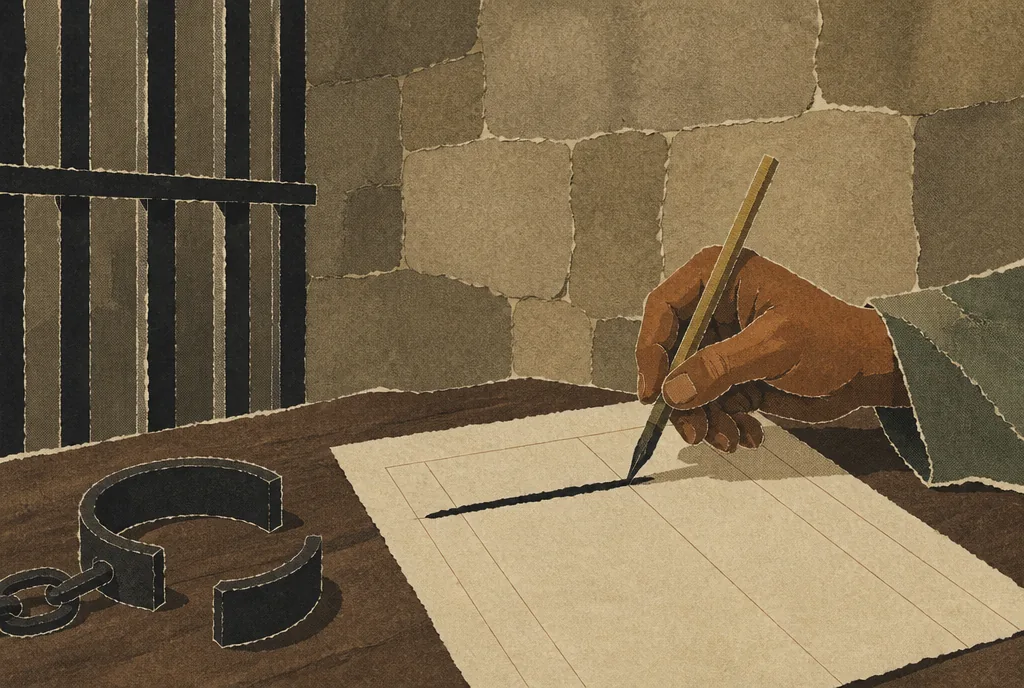
He picks up the pen himself, mid-letter, to sign a debt he did not incur. Then, having offered to pay, he adds one sentence that quietly removes any possibility of Philemon accepting: to say nothing of your owing me even your own self.
Who else was in the room
One detail changes the temperature of the whole thing.
The letter is not addressed only to Philemon. And Apphia our sister and Archippus our fellow soldier, and the church in your house. In the Greek, “your house” is singular — one man’s house. But the greeting at the start and the blessing at the end are both plural — the grace of the Lord Jesus Christ be with your spirit, meaning all of you.
The body presses one man. The envelope is addressed to his congregation. This was read out, and Philemon heard the request standing in a room full of people who had just heard it too — some of whom, in that setting, were very likely slaves themselves.
Then, near the end: At the same time, prepare a guest room for me. Paul is coming. He does not say he is coming to check. He says to get a room ready.
You can read that as warmth or as pressure. I suspect it is both, which is how it goes between people who love each other and want something.
What he does not do
Here is the thing that has troubled readers for centuries, and I am not going to pretend it does not.
Paul does not command Philemon to free him. He does not denounce the institution, or tell Philemon that owning a person is incompatible with the faith he professes. He sends the man back into a legal situation where he could be punished severely, and asks the owner, as a favor, to receive him kindly.
Christians have read this in different ways, and the traditions have not landed in the same place.
Some read the letter as revolutionary by implication — that “no longer as a slave but as a beloved brother” and “receive him as you would receive me” make continued ownership practically impossible, and that Paul is dismantling the thing from inside rather than assaulting it head on.
Others read Paul as constrained by his circumstances, or as not yet seeing what would later be seen.
Others point out that the letter was in fact used for centuries to defend the institution rather than dissolve it — a fact about its history that no honest reading can skip.
I do not think I can settle that here, and I am suspicious of anyone who settles it quickly in either direction.
A letter from the same world
It helps to see what an ordinary version of this letter looked like.
About a generation after Paul, the Roman writer Pliny the Younger wrote to a friend named Sabinianus on behalf of one of his freedmen, who had fallen out with him badly and come to Pliny in tears. Pliny asks him to take the man back — praising his character, disclaiming any wish to apply force, leaning on the friendship. A second surviving letter records that it worked.
So Paul’s opening moves are not original to him. I could command you but I would rather ask was a recognized way of putting a request to a social equal.
The difference is where the letter goes strange again. Pliny wants a household restored to its previous shape, everyone back where they were, with Pliny himself pleasantly at the top of it. Paul asks for something he has no template for: if you consider me your partner, receive him as you would receive me. He is in prison and Onesimus is property, and he asks that whatever welcome would be given to the one be given to the other.
What I do think the letter does
Whatever else is true, notice the mechanism Paul reaches for. He does not use authority, though he says twice that he has it. He uses relationship, debt and shame in the older sense — the appeal of one person to another who owes him everything.
And he puts his own money and name on the line for a man with no standing at all. Charge it to my account is a sentence written by someone who has decided the outcome matters more than being right about who caused the problem.
There is also the name. Onesimus means useful, and Paul plays on it: formerly he was useless to you, but now he is indeed useful to you and to me.
That is a small joke in a serious letter, and it tells you the tone. Paul is not filing a complaint. He is coaxing a friend.

Why it is in the Bible
That question is worth asking, because on the face of it this is somebody’s mail about a private matter.
I think it is there partly because it shows what the theology looked like when it hit an actual situation with an actual cost. The letters around it make enormous claims — that in Christ there is neither slave nor free, that we are all one. Philemon is where somebody has to do something about it, on a Tuesday, with a specific man standing in his doorway.
And it is there, I suspect, because it is unresolved. We do not know what Philemon did. No source tells us with any certainty.
There is one outside trace, and it is small. The letter to the Colossians goes to the same town and names many of the same people — Archippus, Epaphras, Aristarchus, Mark, Demas, Luke. It says Tychicus is on his way there, and with him Onesimus, our faithful and beloved brother, who is one of you. One of you. A Colossian.
That is not the same as knowing what Philemon decided, and later tradition attached stories to the name that I could not verify. But that sentence is there.
It ends with Paul saying he is confident of Philemon’s obedience, and knows he will do even more than I say. Then greetings, and it stops.
The thing that stays with me
Paul writes charge it to my account about a debt that was not his, for a person with no leverage, in his own handwriting, while imprisoned.
You can argue about what he failed to say in this letter, and the argument is legitimate and should not be shut down. But that sentence is in there, and it is the shape of something. A man with nothing to gain putting his name against someone else’s debt so that a relationship could be repaired.
Twenty-five verses. It takes four minutes, and I would read it whole rather than take my word for any of this. Read it out loud and in one go, watching for the two places where Paul says he could order this and then does not. Both are easy to slide past silently and almost impossible to miss aloud.
The passages in this article