
There is a stretch in 1 Kings that does not go the way you expect a story about a prophet to go, the part where Elijah wanted to die.
Elijah has just had the biggest day of his career. Mount Carmel, the contest, fire from heaven, the people on their faces saying the Lord, he is God. By any measure he has won.
The day does not end there, and the rest of it matters. He has the prophets of Baal seized and brought down to the brook Kishon and killed. He climbs the mountain again and prays with his face between his knees, sending his servant to look toward the sea seven times. Then the rain comes, and the last thing the chapter tells us is that he gathered up his garment and ran ahead of the king’s chariot to Jezreel.
A contest, an execution, a long prayer, and a run. One day.
Then Jezebel sends word that she intends to have him dead by this time tomorrow, and he runs again — out of her reach entirely, from Jezreel down to Beersheba, which the text is careful to tell us belongs to Judah. He leaves his servant there. Then a day further into the wilderness, alone. He sits under a broom tree and asks God to let him die. “It is enough; now, Lord, take away my life.”
This is a man who watched fire fall from the sky roughly twenty-four hours earlier.
What God does about it
Nothing you would predict.
There is no correction. Nobody points out that his despair is inconsistent with what he just witnessed, though it plainly is. There is no reminder of Carmel, which would have been the obvious move and is exactly what most of us would say to a friend in that state. You just saw what he can do.
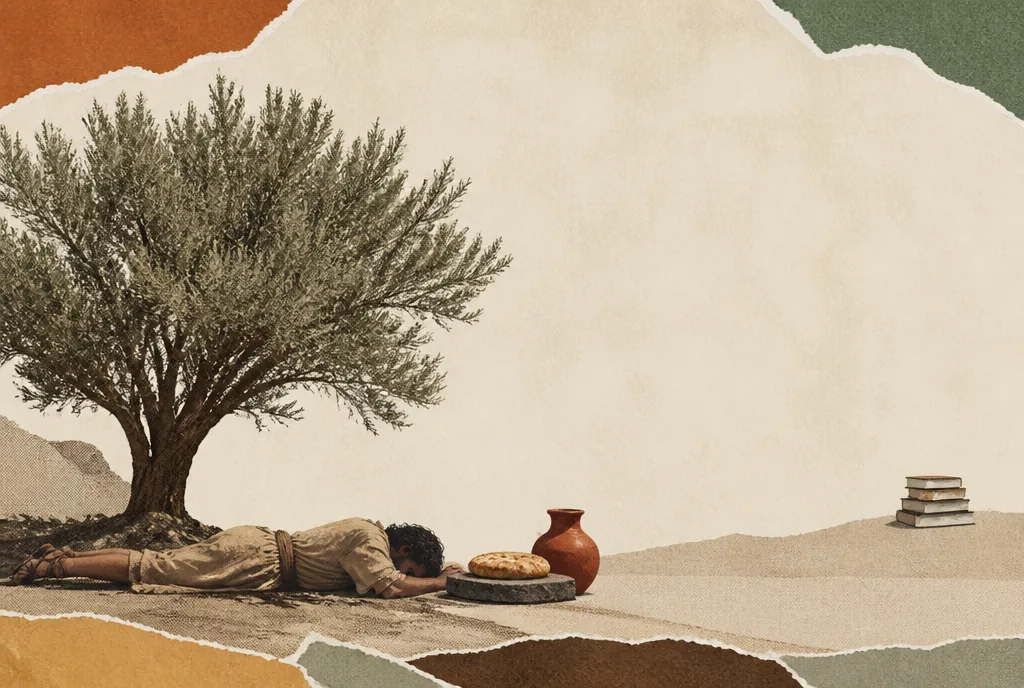
Instead he lies down and sleeps, and an angel touches him and tells him to get up and eat. There is a cake baked on hot stones and a jar of water by his head. He eats and drinks and lies down again.
The angel comes a second time, touches him again, and says one of the more surprising sentences in the book: “Arise and eat, for the journey is too great for you.”
Not you are stronger than you think. Not you have forgotten what I did yesterday. The journey is too great for you.
The word he is answered with
There is something in the Hebrew here that English cannot carry over.
When Elijah sits down and asks to die, the first word out of his mouth is rab. English Bibles render it “It is enough.” It is an ordinary word for much, many, great, abundant, and he is saying: this is too much.
When the angel comes back the second time, the word for the journey being too great for him is the same word. Rab.
He says the weight is too much. The reply, in his own vocabulary, is that the road ahead is too much for him too.
That is not agreement with his request — he asks to die and he does not die. But it is agreement with his measurement. He is not told he is exaggerating. The first thing said to him after this is too much is, in effect, yes.
Then he is given breakfast.
The same holds for the road itself. The narrator says he went a day’s journey into the wilderness, using the word derek that the angel then uses for the road that is too much for him. He had already walked further than he had in him.
The order is the point
Food, sleep, food, then a forty-day walk to Horeb. Only at the far end of all that does anything resembling a conversation happen.
We reverse this constantly. When someone we love falls apart, and when we fall apart ourselves, the first instinct is to go looking for the theological error. What are you forgetting. What do you not believe strongly enough. Where is the gap in your trust that let this in.
Sometimes there is one. But the story is honest about a thing we are not usually honest about: a person can be entirely right about God and still be finished. Elijah’s problem under the broom tree was not that his doctrine had slipped. He was exhausted, terrified and alone, and he had run from Jezreel to Beersheba and then a day further.
You cannot repent your way out of not having slept.
And when the conversation finally does come, look at its shape. It opens with a question — “What are you doing here, Elijah?” — and he is allowed to answer at length, and the answer is bitter and not entirely accurate, and he is not interrupted. Afterward he is asked the same question again, and gives exactly the same speech, word for word. The text records both. He is allowed to say it twice.
He is not the only one
This is also not a one-off collapse by an otherwise unshakeable man.
Moses, buried under the complaining of the people, tells God, “I am not able to carry all this people alone; the burden is too heavy for me,” and asks to be killed rather than see his own wretchedness. Jonah, for entirely different and far less sympathetic reasons, sits outside Nineveh and says twice that it is better for him to die than to live.
Three men, three situations, the same request. Scripture does not tidy any of them out of the record, and it does not stop using any of them afterward.
That does not solve anything by itself. But if some part of you keeps a private ledger in which the thing you said at your lowest point disqualifies you, it is not a ledger the Bible keeps.
Is this just “get some sleep”?
It is a fair objection and it deserves a straight answer, because the cheerful version of this passage does real harm.
No. Some exhaustion does not lift after a good night, a hot meal and a walk. There is a kind of flatness that has been going on for months, that food does not touch, where the thought of not being here has stopped being a phrase and started being a preference. That is not the broom tree at the end of a hard week.
If that is where you are, the honest thing this passage says is that God’s first move toward a man in that state was practical care — and practical care now includes telling a doctor and telling one person who loves you. Needing more than bread is not a failure of faith. Elijah needed more than bread too. He got bread twice, and forty days, and a mountain, and eventually someone to share the work.
Which is the other thing the story does not do. It does not send him back to the same life alone. He is given work — three men to anoint — and one of them is Elisha, appointed “prophet in your place,” which is both a successor and a companion. The man who said I only am left is handed someone to walk with.
What this means for an ordinary week
Less than a sermon and more than it sounds.
It means that when you are flat on a Thursday and your prayer life has gone thin and you feel nothing during worship, the first question is not necessarily spiritual. It is worth asking how you have been sleeping. Whether you have eaten anything that was not from a bag. How long it has been since you talked to someone who is not a colleague.
Those are not lesser questions we get out of the way before reaching the real ones. In this story they are the intervention. God’s first move toward his despairing prophet was a meal and a nap, administered twice, before a single word of instruction.
And it means being slower with other people. When someone tells you they are done, the impulse to correct them is strong and usually wrong. Feed them. Let them sleep. The conversation keeps.
The whisper

The part everyone remembers is the end, where God is not in the wind or the earthquake or the fire, but in what comes afterward.
The Hebrew is three words and none of them is simple — a voice or sound, a word for stillness or hush, and an adjective meaning thin, fine, crushed small. The King James gave us “a still small voice.” Others have tried “the sound of a low whisper,” “a gentle blowing,” “a soft whisper.” Translators have been reaching for it for four hundred years without agreeing. Whatever it was, the text is telling you it was nearly nothing.
It gets quoted as a general observation about how God tends to speak. That is fine as far as it goes.
But notice who it is spoken to. A man who has been fed twice, allowed to sleep, and walked a very long way. The quiet voice arrives at the end of a long stretch of physical care, not instead of it.
And notice what it eventually tells him. Not a rebuke for the broom tree. A correction of one fact: I, even I only, am left was wrong. There were seven thousand.
He could not have known that under the tree, and being told it under the tree would not have helped. He was not in a state to hear a whisper there.
He got there. Slowly, and with a lot of bread.
The passages in this article
1 Kings 19:1-18, 1 Kings 18:20-46, Numbers 11:11-15, Jonah 4:1-9