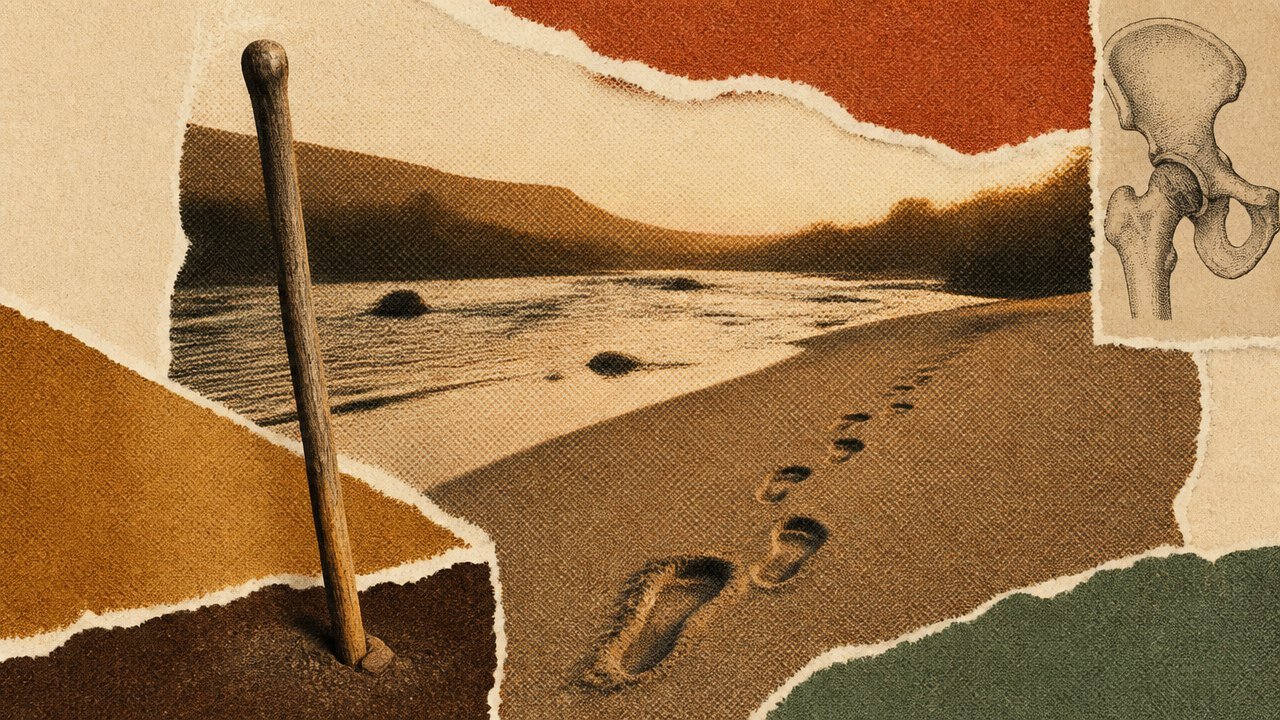
Jacob spends a night wrestling with someone the text refuses to fully name, and wins, and never walks properly again.
It is one of the strangest passages in Genesis, and the strangeness is deliberate. Nearly every detail resists being tidied.
What happens
Jacob is on his way back to meet Esau, the brother he cheated twenty years earlier and has every reason to fear. He sends his family and everything he owns across the river ahead of him and is left alone.
And a man wrestled with him until the breaking of the day.
A man. That is what the text says. It will get more suggestive later, but it opens with a man, and the ambiguity is never fully removed.
When the man sees he is not prevailing, he touches Jacob’s hip socket and puts it out of joint.
Then he says something that ought to stop you: Let me go, for the day has broken.
He asks to be released, and the reason he gives is the sunrise. Genesis explains neither half.
Still Jacob will not let go. I will not let you go unless you bless me.
He is asked his name. He gives it — which matters, because the last time he was asked who he was, in his father’s tent, he lied.
And he is given a new one. Your name shall no longer be called Jacob, but Israel, for you have striven with God and with men, and have prevailed.
He asks the man’s name in return and does not get it. Why is it that you ask my name? And then, without an answer: And there he blessed him. The blessing is given, the name withheld.
Jacob names the place himself, and the name is his verdict on the night. Peniel — For I have seen God face to face, and yet my life has been delivered.
Then the sunrise: The sun rose upon him as he passed Penuel, limping because of his hip.
The detail that fixes it in place
Genesis adds a note that most readers skip.
Therefore to this day the people of Israel do not eat the sinew of the thigh that is on the hip socket, because he touched the socket of Jacob’s hip on the sinew of the thigh.
A dietary practice, still observed at the time of writing, commemorating an injury.
That tells you something the narrative alone would not: the limp was not a passing bruise. It became a permanent marker, remembered in the ordinary act of eating, for generations.
Even here the text keeps its habit. The Hebrew phrase for what is not eaten is gid hannasheh, and the lexicons will not say with confidence which part of the body it names. The practice is specific and the anatomy is not.
What the text will not tell you
The gaps are worth listing plainly. They are not artifacts of translation; they are in the Hebrew, and they look deliberate.
Who the man is. Jacob concludes afterwards that he has seen God — but that is Jacob’s conclusion, offered as his reason for a place name. The narrator never confirms it.
Why he could not prevail. The text states flatly that he did not, and then that he ended the match with one touch. Both reported. Neither reconciled.
Why he had to leave at daybreak.
Even the new name arrives with a question attached. Israel, for you have striven with God and with men, and have prevailed. The text supplies its own gloss, and that gloss is what matters for reading the story. But scholars have argued a long time over what the name is built from — most take the second half as God and the first as a verb for striving or ruling or persisting, and the lexicons list the options without choosing between them.
The detail Hosea adds
One other place in Scripture goes back to this night, and it brings something Genesis left out.
Hosea, arguing with a nation named after the man, sums him up in two lines: In the womb he took his brother by the heel, and in his manhood he strove with God. He strove with the angel and prevailed; he wept and sought his favor.
He wept.
Genesis gives you a grip, a dislocated hip and a demand. No tears anywhere. Hosea, centuries later, remembers the night as a man weeping and begging — and calls the opponent the angel, which is a different sort of claim from Jacob’s own and does not close that question either.
Readers handle that in different ways — Hosea drawing on a fuller telling, or Hosea reading the demand correctly, since I will not let you go unless you bless me was never said calmly. I lean toward the second, loosely. Genesis says what the night looked like. Hosea says what it was.
Blessed and limping in the same sentence
Here is what I keep returning to.
The text does not treat the blessing and the injury as being in tension. They arrive together. He prevails and he is damaged, and Genesis reports both in the same breath without embarrassment and without explanation.
We are not built to read it that way. We instinctively sort outcomes into wins and losses. If the night was a victory, the hip should have healed. If he was left limping, something must have gone wrong.
Genesis simply declines the sorting.
Why this matters
There is a version of faith on offer — it is rarely stated outright, which is what makes it durable — in which coming through a hard thing means coming through intact.
You go in, God meets you, and you emerge stronger. Stronger, notably, in the sense of undamaged. The testimony gets told that way. The difficult stretch becomes a chapter with a clean resolution.
And most people who have actually been through something know that is not how it goes.
You come out changed. Frequently you come out with something that does not work the way it used to. A capacity for trust that is now more careful. A relationship that never returned to what it was. A faith that is smaller and stranger and much harder to shift. Something in you that aches in cold weather.
The instinct is to treat that as evidence that you failed the test. That someone with more faith would have emerged whole.
This passage says otherwise, and it says it in the most compressed way available: the blessing and the limp are in the same verse, and the man who received both is renamed for having prevailed.
What he actually got
Notice what Jacob asks for and what he gets.
He demands a blessing and receives a new name — which in that world is not decoration, it is identity. He asks for the man’s name and is refused.
So he leaves with more than he came with and less than he asked for, and permanently marked.
That is a fairly accurate description of most encounters with God that I have heard people describe honestly. Something was given. Something was withheld. Something was changed and did not change back.
The name that did not take
Here is something you can check in a minute with nothing but a Bible on the table.
He is renamed Israel. And then the very next chapter opens: Jacob lifted up his eyes. The narrator goes straight back to the old name and mostly stays there.
Compare Abram. Once God renames him Abraham in chapter 17, Genesis never calls him Abram again — not once. Sarai becomes Sarah in the same chapter and stays Sarah. Jacob is renamed and carries on being Jacob, with Israel used alongside it, sometimes in the same chapter. Then, three chapters later at Bethel, God renames him again — same name, more or less the same words.
Readers have made different things of that. Some see two accounts of one event side by side. Some see a renaming repeated because the man was slow. Some see the text declining to pretend a person is ever finished.
I will not choose for you. But if you have ever been given something at a particular moment and then found yourself weeks later back under your old name, wondering whether any of it held — the man this people is named after had that experience, and Genesis records it without alarm.
Reading it now
The sentence I would sit with is the sunrise one, because of the order of the clauses.
The sun rose upon him as he passed Penuel, limping.
The dawn and the limp in the same line. He crosses over into the country of the promise, at daybreak, under a new name, slowly, with a bad hip.
If you are carrying something out of a season that other people cannot see — and if some part of you is still waiting to get back to who you were before it — this passage has a category for that.
If you want something concrete to do this week, write two lines on a piece of paper. What was given. What was withheld. Jacob came off that riverbank able to name both. Most of us can name one and not the other, and in my experience it is the giving we have the harder time writing down.
You can be blessed and be limping. Genesis does not treat those as opposites.
He went on to meet his brother that morning. The text says nothing about him waiting until he had recovered.
The passages in this article
Genesis 32:22-32, Hosea 12:3-4, Genesis 35:9-10, Genesis 17:5, 15, Genesis 33:1