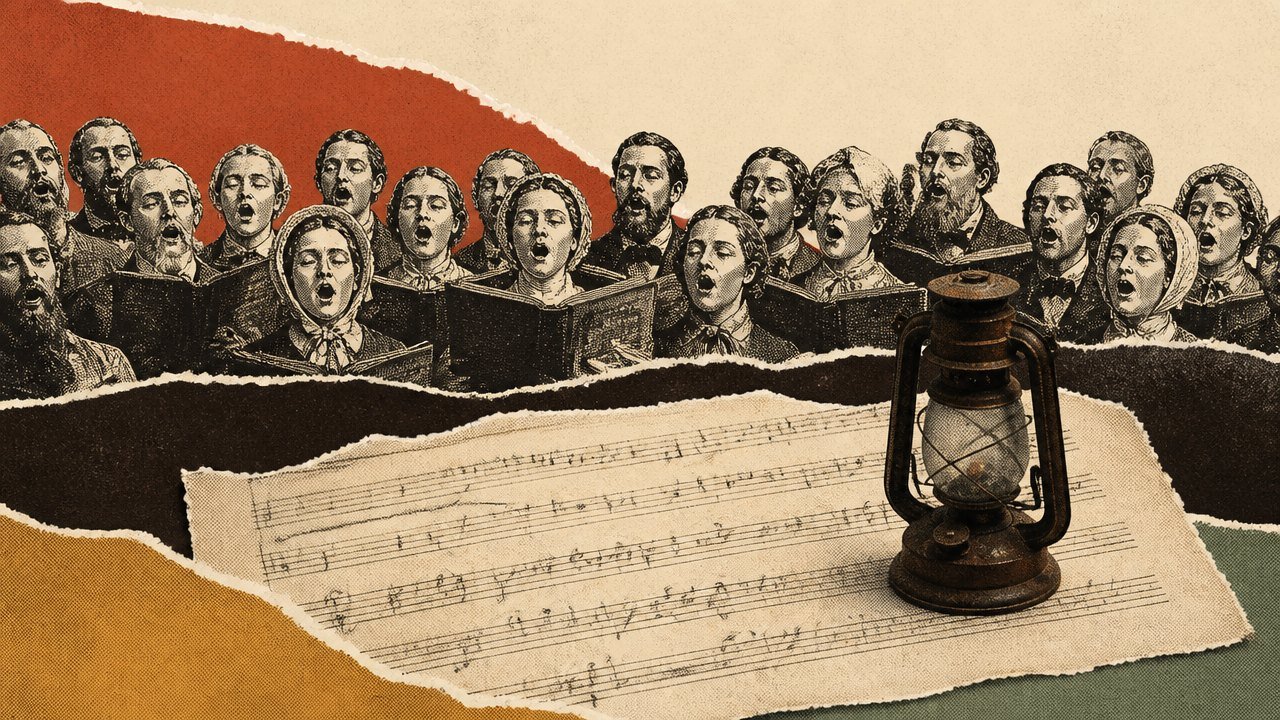
We read the psalms privately, quietly, alone, usually in the morning, as though we were reading someone’s journal, and forget they are psalms meant to be sung.
That is not how they were used, and once you see it the whole collection reorganizes itself.
Look at the headings
Most Bibles print a small line of text above many of the psalms, in smaller type, which almost everybody skips.
To the choirmaster. A Psalm of David. According to The Doe of the Dawn. With stringed instruments. According to Lilies. A Song at the dedication of the temple.
Those are performance notes.
A choirmaster is a person with a job. Stringed instruments are equipment. Tune names — and that is what several of these appear to be — mean somebody expected a congregation to know the melody.
These are the production credits of a hymnal.
They are also nearly everywhere. In the Hebrew text roughly a hundred and sixteen of the hundred and fifty psalms carry some kind of heading; only around thirty-four have none at all. One instruction on its own — to the choirmaster — sits on top of about fifty-five of them.
And it is not only the headings. Scattered through the psalms themselves, seventy-one times, is the word Selah, with three more in Habakkuk. Nobody knows for certain what it means. The best guesses are a pause, a musical interlude, a cue of some sort. The honest position is that it is a direction printed inside a song for people who already knew what to do when they saw it, and we are reading somebody else’s sheet music.
The ones that name an occasion
Some of the headings do something different. They tell you when.
Psalm 51: To the choirmaster. A Psalm of David, when Nathan the prophet went to him, after he had gone in to Bathsheba.
Psalm 34: Of David, when he changed his behavior before Abimelech, so that he drove him out, and he went away.
Psalm 60 carries what amounts to a situation report — Aram-naharaim, Aram-zobah, Joab, twelve thousand Edomites in the Valley of Salt.
Here I want to be straight with you about something, because it is easy to slide past. Readers have differed for a very long time over whether these headings came with the psalms or were added later by the people who collected them. Before the nineteenth century most interpreters took them as original. Through the nineteenth and twentieth centuries most scholars treated them as later editorial work, and many still do; others have argued back toward their antiquity, on the basis of how song collections were labeled elsewhere in the ancient world. The old Greek translation of the Psalms even supplies headings for psalms the Hebrew leaves bare.
I am not going to settle that, and you do not need it settled to notice the part nobody disputes: whoever wrote them, somebody was organizing these for use. You do not file a poem under a tune name and a choirmaster unless it is going to be sung.
Which changes the emotional ones
Take Psalm 88, the darkest thing in the collection. It runs through being cut off, abandoned, calling out day and night with no answer, and it ends: You have caused my beloved and my friend to shun me; my companions have become darkness. No turn, no resolution.
Now read its heading.
To the choirmaster: according to Mahalath Leannoth.
It has a tune. It was given to the worship leader. Somebody set that to music and a congregation sang it together, out loud, on purpose.
I find that genuinely startling. Not because the psalm is despairing — plenty of Scripture is honest about despair — but because the despair was scheduled. It was scored, rehearsed and performed corporately by people who were not all in that condition that week.
Why corporate matters
Here is the practical difference.
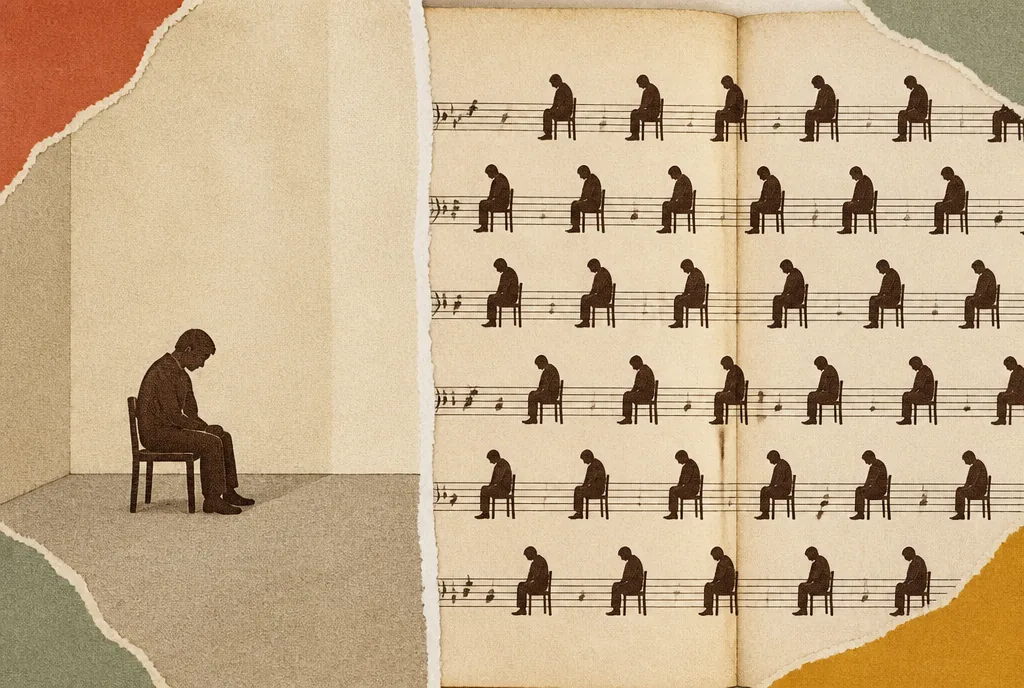
Read privately, Psalm 88 is a record of one man’s terrible night, and if you are not in that place it can feel like an intrusion, or like nothing.
Sung corporately, it does something else entirely. It means that on any given Sunday, the room says the words on behalf of whoever in it needs them. The people who can sing carry the ones who cannot. And the ones who cannot hear their own condition spoken aloud, publicly, sanctioned, in the assembly, as a legitimate thing to say to God.
That is a completely different function. It is not self-expression. It is provision.
Which also explains something that puzzles people about the psalms: why they swing so violently. Exuberant praise, then a psalm of pure complaint, then a national song, then a private confession. As a diary that is incoherent. As a hymnal it is obvious. A congregation contains all of those people at once, every week.
Somebody had to run the music
The headings name people, and the people turn out to have jobs.
Psalm 88’s belongs to the Sons of Korah, and it is A Maskil of Heman the Ezrahite. Others belong to Asaph. These are not one-off poets. They are named families and guilds attached to the music of Israel’s worship, and they turn up elsewhere in Scripture doing exactly that work. Chronicles records David putting the first thanksgiving song into the hand of Asaph and his brothers. Centuries later, under Hezekiah, the Levites are told to sing praise with the words of David and of Asaph the seer — which is a sentence about a repertoire. Old material, still in use, somebody keeping it.
There is even a visible seam. At the end of Psalm 72 comes a line that has nothing to do with the psalm above it: The prayers of David, the son of Jesse, are ended. That is a collection being closed and filed, left sitting in the text seventy-eight psalms before the book actually finishes.
And Psalms 120 to 134 all carry the same two-word heading, A Song of Ascents — most commonly read as the songs of pilgrims going up to Jerusalem for the festivals. Fifteen in a row, grouped for a walk people made together, on foot, several times a year.
None of that is decoration. It is the infrastructure of a singing people, and the book we read privately is the surviving paperwork.
The uncomfortable ones
This also gives us a way to hold the psalms most of us skip.
The imprecatory psalms — the ones calling down destruction on enemies — are hard to read devotionally. As private prayer they are alarming.
As corporate song, sung by a people who had been invaded, deported, and had their children killed, they read differently. Not comfortable, but comprehensible: a community bringing its rage into the assembly rather than into the street. Christians differ on how to pray them now, and I am not going to settle that. But knowing they were sung, together, by a whole people, is the first thing to know about them.

What this means for you on Tuesday
Four practical things.
Read the small line first. It takes two seconds and it is already printed on the page. Notice whether the psalm was handed to a choirmaster, whether it has a tune, whether it belongs to a guild, whether it names an occasion. Before you have read a word of the psalm, you are being told what it was for.
Read them out loud. They were made for the mouth and the ear. Reading a psalm silently removes most of what it is doing. Ninety seconds, out loud, alone in a room, changes the experience more than any commentary will.
Do not only read the ones that match your mood. The point of a hymnal is that you sing things that are not currently true of you. If today is fine, Psalm 88 is not for you — it is for you to learn, so that you have it when it is, and so that you can sing it beside somebody who needs it.
And when you have no words, use theirs. This is the oldest advice in Christian devotion and every tradition gives it. On the days when nothing will come, the collection exists precisely for that. You do not have to generate anything. Somebody already wrote it down and set it to music and handed it to the choirmaster, three thousand years ago, so that it would be there when you needed it.
One thing to try
Find a psalm that does not match your week at all.
If things are good, read a lament. If things are bad, read a psalm of praise — not to fix your mood, but because it is true independently of you.
Read it out loud once, slowly.
That is what a songbook is for. You do not only sing the songs that describe you. You sing the ones the room needs, and some weeks you are carried, and some weeks you carry.
The passages in this article
Psalm 88, Psalm 51, Psalm 34, Psalm 60, Psalm 72:20, Psalms 120-134