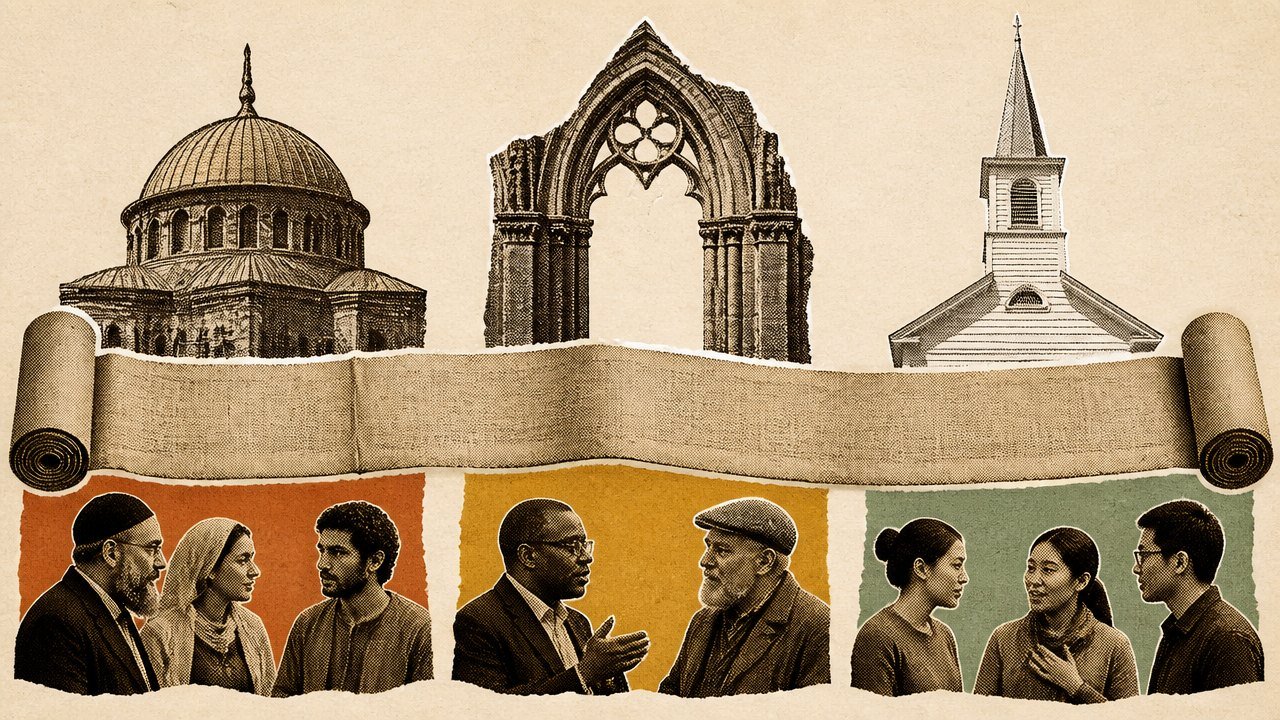
There is a sentence being said this Sunday in a Greek Orthodox parish in Astoria, in a Catholic cathedral in São Paulo, in a Presbyterian church in Aberdeen, and in an Anglican chapel in Nairobi. Mostly it is said in different languages, at different points in the service, by people who would disagree with each other about a great many things if you sat them down together. This is the Nicene Creed explained.
It is very nearly the same sentence.
I believe in one God, the Father almighty, maker of heaven and earth, of all things visible and invisible.
I want to spend some time on that, because I think most of us underestimate what it means. We are extremely aware of what divides Christians. It is the water we swim in. There are whole publishing industries devoted to the differences, and there are real differences, and I am not going to pretend otherwise.
But there is a text that Orthodox, Catholic and Protestant Christians all say out loud, on purpose, as a statement of what they actually believe. And it is not a modern compromise document produced by a committee trying to find the lowest common denominator. It is older than any of the divisions it now spans.
Where it came from
The creed we call Nicene was not written in one sitting.
The first part came out of a council at Nicaea in 325, called because a presbyter named Arius had been teaching that the Son was a created being — exalted, first of all creation, but made. The council said no, and said it in a very specific way: the Son is of one being with the Father. Begotten, not made.
That sounds like technical vocabulary now. At the time it was a fight about whether the person Christians worshiped was God or something less than God, which is not a small question.
The second part came from a council at Constantinople in 381, which affirmed what Nicaea had said and extended it, adding the section on the Holy Spirit. That is where the creed gets the shape we recite.
So the text is fourth century. It predates the split between East and West by roughly seven hundred years. It predates the Reformation by about eleven hundred. When a Baptist and a Greek Orthodox believer say it, they are not agreeing to a truce drawn up in the meantime. They are both reaching back past the arguments to something that was there before any of them.
What it actually claims
Read it slowly and it is a remarkably concrete document. It is not a list of values. It is mostly a series of statements about things that happened.
He came down from heaven. He was incarnate. He was made man. He was crucified under Pontius Pilate — and there is a Roman administrator’s name in the middle of a worship text, which is a strange and wonderful thing. He suffered. He was buried. He rose again on the third day, according to the Scriptures. He ascended. He will come again.
Almost none of that is a sentiment. It is a claim about events, with a name and a date attached to one of them.
I find that clarifying on the weeks when faith feels thin. The creed does not ask how I am feeling about any of this. It asks whether these things happened. And when I cannot summon much interior warmth, I can still say a sentence about something that either occurred or did not, and mean it, and let the feeling catch up later.
There is a reason the church put this in the mouths of ordinary people rather than leaving it in a theological library.

The one word we do not agree on
I said very nearly the same sentence, and I meant it.
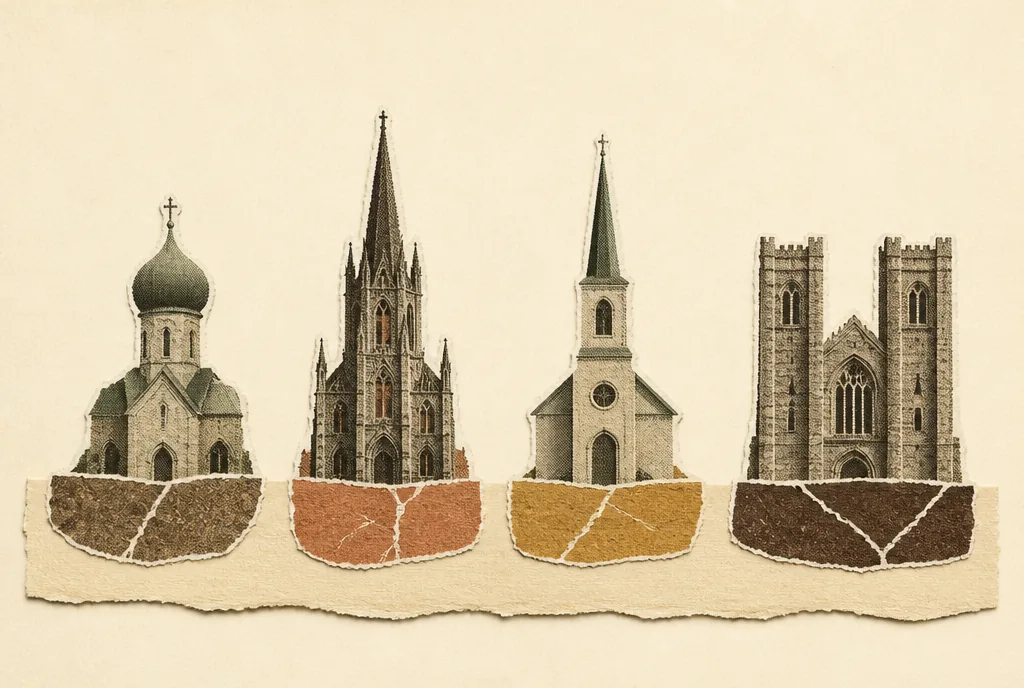
There is a clause where the Western and Eastern texts differ. The creed of 381 says the Holy Spirit proceeds from the Father. In the West, over time, the words and the Son — in Latin, filioque — came to be added.
The history is worth knowing because it is less dramatic than the controversy suggests. The addition seems to have entered formally at a regional council in Spain in 589, where the local church was contending with lingering Arianism and wanted to say something emphatic about the Son. It spread gradually through the Frankish churches. Rome resisted it for a long time; Pope Leo III declined to add it to the creed in the early ninth century even while affirming the theology behind it. It was only early in the eleventh century that it entered the creed as used in Rome.
The Eastern objection has always had two parts. One is theological, about the relation of the Spirit to the Father. The other is procedural, and it is the one people forget: the Council of Ephesus in 431 forbade the composition of another creed, and the Orthodox position is that a text agreed by an ecumenical council cannot be amended by one part of the church acting alone.
I am not going to settle that here. I do not think I could, and I am fairly sure it would be presumptuous to try in an article of this length when it has occupied better minds than mine for twelve centuries.
What I will say is this. Notice how much of the creed is left standing after you set that clause aside. The Trinity. The incarnation. The virgin birth. The crucifixion under a named Roman official. The bodily resurrection. The ascension. The return. The Spirit as Lord and giver of life, worshiped and glorified together with the Father and the Son. One baptism for the forgiveness of sins. The resurrection of the dead and the life of the world to come.
That is not a thin residue. That is nearly the whole of the Christian faith, held in common by people who have spent a thousand years unable to share communion.
Why this matters on a Tuesday
You might reasonably ask what a fourth-century conciliar document has to do with your week.
Two things, I think.
The first is that it tells you what you are actually required to believe, and it is less than you may fear and more than you may hope. Less, because a great deal of what circulates as Christian conviction is not in there — political positions, cultural preferences, opinions about which translation is best, entire systems of end-times chronology. None of that made the creed. More, because what is in there is genuinely demanding. A man rose from the dead. He is coming back. There is a life of the world to come and you are going to be in it.
The second is that it is said in the first person plural in most of its liturgical forms, and even where it begins I believe, it is being said by a room. On the weeks when you cannot manage it, the room is still saying it, and you are standing inside a sentence that has been carried by people for seventeen hundred years, most of whom also had weeks when they could not manage it.
There is something steadying about a text that does not depend on your current condition. You do not have to generate it. You inherit it, and you say it, and on the days you can hardly get the words out, it holds the shape of the thing until you can.
A small practice
Try reading it slowly, once, out loud, this week. Not in a service, where it goes past at the speed of the congregation. Alone, at the speed of speech, stopping where you want to stop.
You will probably find one clause snags. It is different for different people and different years. Sometimes it is the resurrection of the dead. Sometimes it is one holy catholic and apostolic church, and what on earth that means given everything. Sometimes it is simply I believe, said honestly, by someone who is not sure.
Snagging is fine. It is a sign you are reading it rather than reciting it.
And the rest of the sentence keeps going, said by a great many other people, in a great many other rooms, this Sunday.