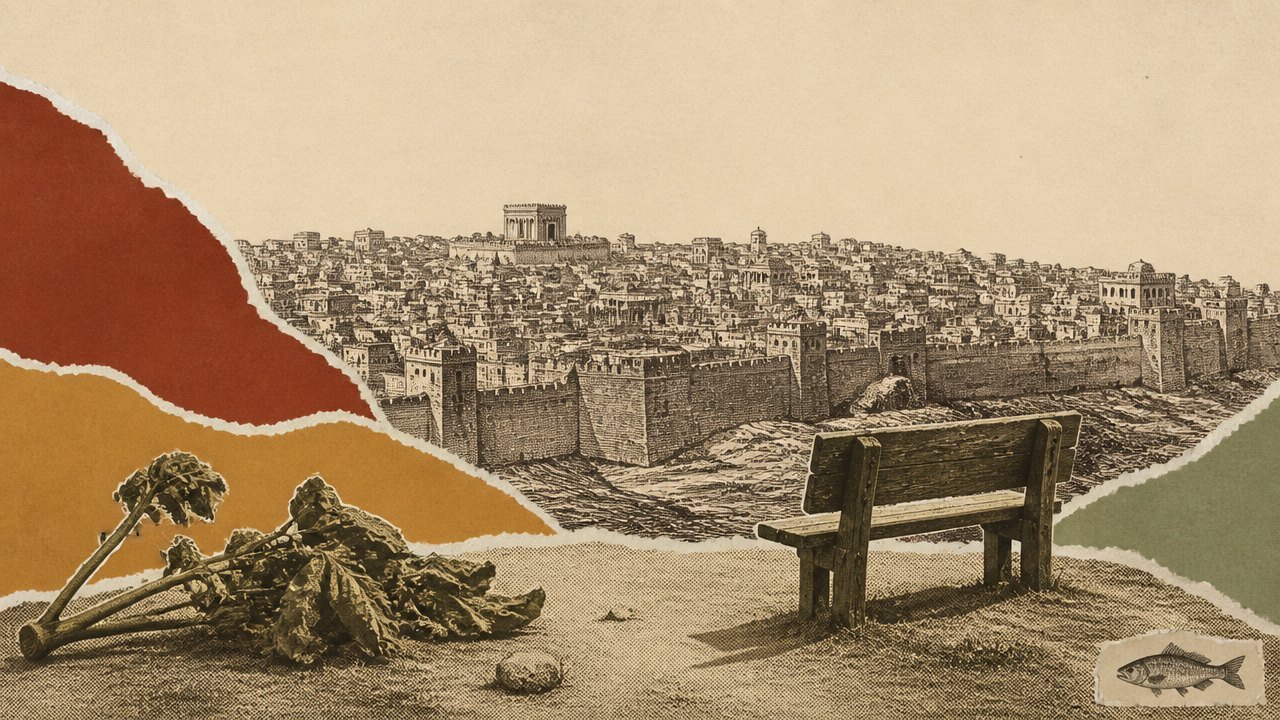
Ask anyone what happens in the book of Jonah and you will get the fish, not the sign of Jonah.
It is the one detail that survives childhood. Felt boards, illustrated Bibles, the whale with the astonished eye. And it takes up exactly one verse.
And the Lord appointed a great fish to swallow up Jonah. And Jonah was in the belly of the fish three days and three nights.
That is all of it. The book is forty-eight verses long, and the part everyone remembers is one of them.
What is strange is that Jesus reaches for this book too, and what he does with it is not what we do with it.
Two versions of the same saying
Some scribes and Pharisees ask for a sign. Jesus refuses, and then does not quite refuse.
An evil and adulterous generation seeks for a sign, but no sign will be given to it except the sign of the prophet Jonah. For just as Jonah was three days and three nights in the belly of the great fish, so will the Son of Man be three days and three nights in the heart of the earth.
That is Matthew. It is the version most of us carry, and the fish is in it — three days under, three days buried.
Luke records the same saying and the fish is not there at all.
This generation is an evil generation. It seeks for a sign, but no sign will be given to it except the sign of Jonah. For as Jonah became a sign to the people of Nineveh, so will the Son of Man be to this generation.
No belly. No burial. In Luke, the sign of Jonah is Jonah — a man who turned up in a city that was not his own and said something the city had not asked to hear.
The two gospels are not at war here. They are holding different ends of the same thing, and it is worth noticing that only one end made it into our memory.
A note in passing, since it is the first thing many readers ask: “three days and three nights” against a Friday evening burial and a Sunday morning rising has been discussed by careful Christians for a very long time, usually by way of the ordinary reckoning in which any part of a day counts as a day. It is a real question. It is not the point of the saying, and the saying does not turn on it.

What both versions agree on
Here is the part I had read past for years. Matthew and Luke record the fish differently, but the sentence that comes next is nearly word for word the same in both.
The men of Nineveh will rise up at the judgment with this generation and condemn it, for they repented at the preaching of Jonah, and behold, something greater than Jonah is here.
So in both gospels, whatever else the sign of Jonah involves, it ends with Nineveh. Not with the fish. With the people who heard a foreigner preach and changed.
And that is where the book of Jonah ends too.
The ending nobody teaches
The fish is chapter one. The book keeps going for three more.
Jonah preaches. The city repents. God relents. And then:
But it displeased Jonah exceedingly, and he was angry.
The prophet is furious that his mission worked.
His prayer of complaint is worth reading slowly, because of what he uses as ammunition:
O Lord, is not this what I said when I was yet in my country? That is why I made haste to flee to Tarshish; for I knew that you are a gracious God and merciful, slow to anger and abounding in steadfast love, and relenting from disaster.
That is not a random description of God. It is one of the oldest confessions in the Hebrew Scriptures — the words God speaks about himself to Moses, repeated in the Psalms, prayed for centuries.
Jonah quotes the creed as an accusation. I knew you would be like this. He ran because he was afraid mercy would show up, and it did, and he would rather die than watch.
Nineveh was the capital of Assyria. These were not neutral strangers. This was the empire whose armies would eventually break his nation apart. Jonah’s anger is not petty. It is the anger of a man watching God be kind to people who have hurt his own.
A plant, a worm, and a question
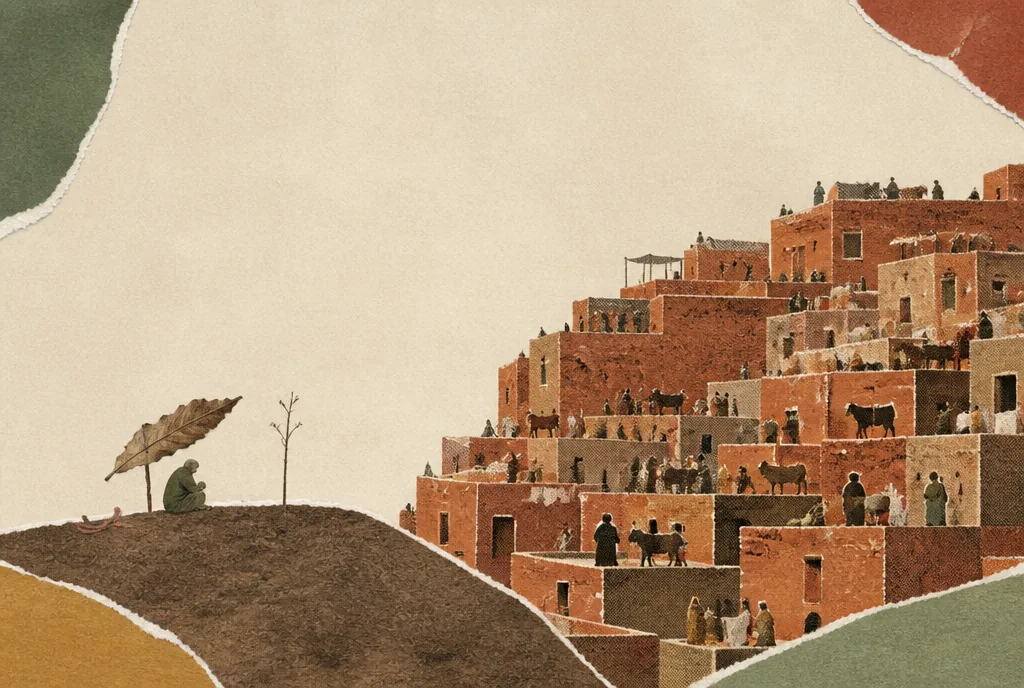
So Jonah goes out east of the city, builds himself a shelter, and sits down till he should see what would become of the city. He is waiting to see whether the fire might still fall.
God appoints a plant for shade, and Jonah is exceedingly glad — the only time in the entire book he is happy, and it is about a plant.
Then a worm. Then a scorching wind. Then the plant is gone and Jonah wants to die again.
And the book ends. Not with a resolution. With a question:
You pity the plant, for which you did not labor, nor did you make it grow, which came into being in a night and perished in a night. And should not I pity Nineveh, that great city, in which there are more than 120,000 persons who do not know their right hand from their left, and also much cattle?
That is the last line. God asks Jonah whether he ought to have mercy on a city, and Jonah does not answer.
The book will not tell us what he said, because the question is not really being asked of Jonah any more.
Why this is the sign
The sign of Jonah, in Matthew, includes a burial and a rising. I do not want to lose that; Jesus put it there.
But in both gospels the sign lands on the same place: a city that had no claim on God’s mercy received it, and the people who should have recognized what was happening in front of them did not.
Something greater than Jonah is here.
Greater in what sense? Not louder. Jonah’s whole sermon in Nineveh is five words in Hebrew — yet forty days, and Nineveh shall be overthrown — and it names no God, offers no terms, and does not once suggest that repentance is on the table. The city works that out for itself. Greater, then, in that the mercy Jonah resented is now standing in the room, offering itself in person to the people asking for a sign.
Reading it now
I think the reason the fish took over is that the fish is the safe part. It is a miracle at a distance, easy to argue about, easy to picture, and it asks nothing of me.
The rest of the book is much closer to home.
Most of us do not have a Nineveh in the sense of an empire. But most of us have a short list — the person, the family, the group, the kind of people — whose ruin we would not exactly celebrate but whose flourishing would sit badly with us. We have all felt, somewhere below the level we would say out loud, that mercy was fine in general and misapplied in that particular case.
Jonah is the book that takes that feeling seriously enough to write four chapters about it, and gentle enough not to shame the man who has it. God does not strike Jonah down. God gives him shade, and then takes the shade away, and then asks him a question.
The question is still open at the end because it is being asked of whoever is reading.
And should not I pity them.
The passages in this article
Jonah 4, Matthew 12:38-42, Luke 11:29-32, Jonah 1:17, Jonah 3, Exodus 34:6