We tend to file the book of Ruth under love story. It is short, it ends well, there is a wedding, and it contains one of the most quoted lines in Scripture, usually printed on something with a floral border.
Where you go I will go, and where you lodge I will lodge. Your people shall be my people, and your God my God.
Almost nobody remembers who says it, or to whom, or what it cost her.
Start with the law
Deuteronomy 23:3 is not a verse you will hear at a wedding.
No Ammonite or Moabite may enter the assembly of the LORD. Even to the tenth generation, none of them may enter the assembly of the LORD forever.
Ten generations. The text gives reasons — the Moabites did not meet Israel with bread and water on the way out of Egypt, and they hired Balaam to curse them.
Keep reading, because four verses later the same law goes somewhere you would not expect.
You shall not abhor an Edomite, for he is your brother. You shall not abhor an Egyptian, because you were a sojourner in his land. Children born to them in the third generation may enter the assembly of the LORD.
Egypt. The country of the slavery, the bricks, the pursuit to the sea — third generation. Moab, whose recorded offense was refusing bread and water on a road — tenth, and the word forever is in the sentence.
I am not going to explain that away. Honest readers have found it hard for a very long time.
So there is a standing exclusion, written into the law, aimed at a specific people.
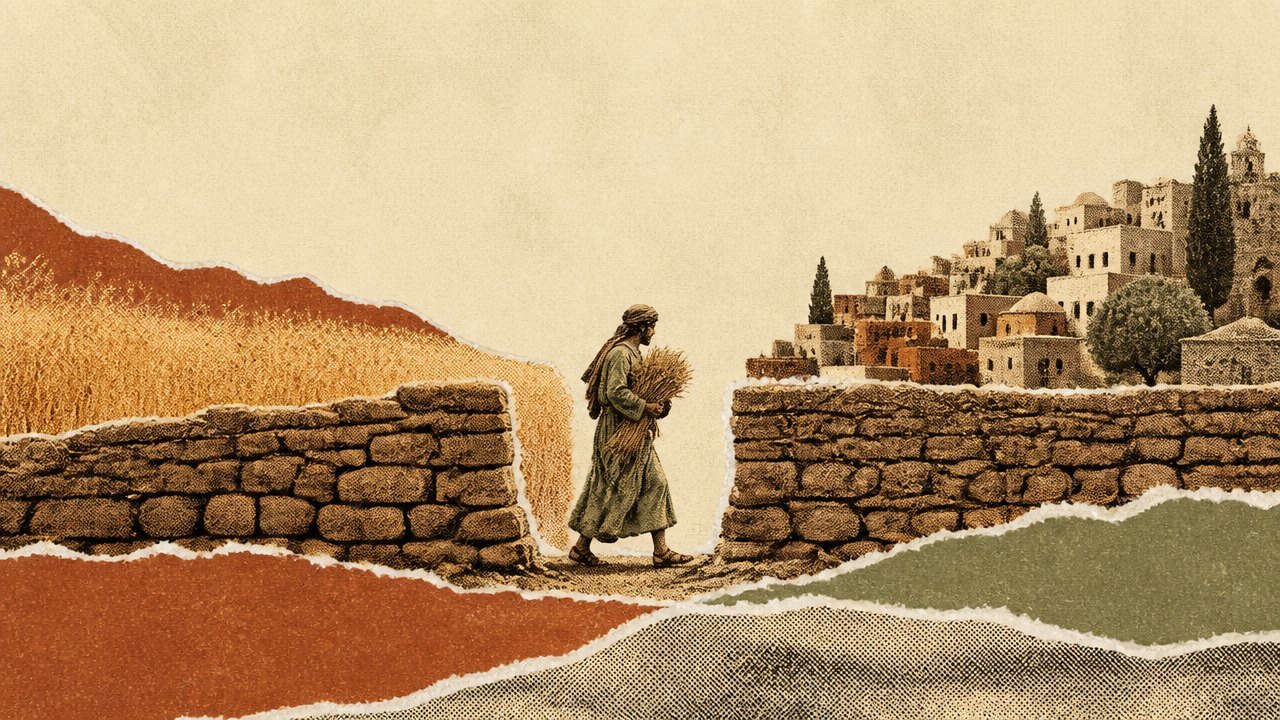
Now open the book of Ruth. In the first five verses, an Israelite family leaves Bethlehem because of famine and settles in Moab. The two sons marry Moabite women. Within a few more verses all three men are dead, and Naomi is left with two foreign daughters-in-law and nothing else.
The book is going to spend four chapters on one of those women.
The line, in context
Naomi tells them both to go home. She has nothing to offer them — no more sons, no prospects, no future. Orpah does the sensible thing and goes.
The narrator does not fault Orpah, and neither should we. She does exactly what her mother-in-law instructs, kisses her goodbye, and goes back to a possible life. Nothing in the book calls that wrong.
Ruth does not.
The verb is worth knowing. Ruth clung to her. That is the same Hebrew verb Genesis 2:24 uses for the man who leaves his father and mother and holds fast to his wife. It is the marriage word, used here of a widow and her dead husband’s mother.
And the famous line is not a wedding vow. It is a destitute foreign widow attaching herself permanently to a bitter older woman with no money, walking away from her own people and her own gods, toward a country whose law had a clause about people like her.
Your people shall be my people, and your God my God.
She is not gaining anything. There is no upside in the sentence. She is choosing the harder of two bad options because of loyalty to one person.
What happens when she arrives
They get to Bethlehem and the town is stirred. The women say, Is this Naomi?
And Naomi answers with the line I find hardest in the book: Do not call me Naomi; call me Mara — bitter — for the Almighty has dealt very bitterly with me. I went away full, and the LORD has brought me back empty.
She says this standing next to Ruth.
Empty. With the woman who gave up everything for her standing right there.
I do not think the book intends that as a criticism of Naomi. Grief does not do arithmetic. But the narrator lets us see it, and lets us notice that Naomi cannot yet count the person beside her as anything.
The gleaning
Ruth goes to work, and the detail matters.
Gleaning was welfare legislation. The law required landowners to leave the edges of the field and whatever was dropped, so that the poor and the foreigner could gather it. It was not charity in the modern sense; it was a legal right, exercised by walking into someone’s field and taking what was left.
It was also exposed and dangerous work for a young foreign widow, which is why Boaz tells his men to leave her alone, and why he tells her to stay with his young women.
The narrator keeps calling her Ruth the Moabite — long after we know it. Chapter after chapter, right through the property transaction in chapter four, where she is twice called the Moabite. It is not carelessness. He will not let the reader forget which side of the Deuteronomy line she came from.
Which is worth holding next to the statutes she is living off. Leviticus tells the landowner not to reap to the edge or strip the vineyard bare, and to leave what remains for the poor and for the sojourner. Deuteronomy names them again — the sojourner, the fatherless, and the widow — and gives a reason: you shall remember that you were a slave in the land of Egypt.
Ruth is the sojourner and the widow of that sentence, both at once, in a field, in a country whose law also had a clause about her nationality. Both things are in the same five books.
Wings
Boaz says a generous thing to Ruth in the field, the first time they meet.
The LORD repay you for what you have done, and a full reward be given you by the LORD, the God of Israel, under whose wings you have come to take refuge.
It is a lovely blessing and it costs him nothing at all. He is asking God to look after her.
A chapter later, in the dark, on the threshing floor, Ruth says this:
I am Ruth, your servant. Spread your wings over your servant, for you are a redeemer.
Same Hebrew word both times — a bird’s wing, and also the corner or skirt of a garment. Boaz had asked God to shelter her under God’s wings. Ruth hands the blessing back to him as a request: be the answer to your own prayer.
He does not flinch. He calls her a worthy woman — the two Hebrew words that open the famous poem at the end of Proverbs. In some Hebrew orderings, Ruth sits immediately after Proverbs, and readers have long noticed that the poem opens by asking who could ever find such a woman, and the next book answers with a Moabite widow in a field.
One more word runs under all of this, and English has never had a single equivalent for it. Chesed — kindness, steadfast love, loyalty, loving devotion, and none of them lands. It is the loyalty that keeps going after the obligation has run out. It occurs three times in four chapters, and every time it describes someone doing more than was required of them.
The last line of the book
The story resolves with Boaz redeeming the family land and marrying Ruth, and a child is born.
Then the book closes with a genealogy, which sounds like an anticlimax until you read it.
They named him Obed. He was the father of Jesse, the father of David.
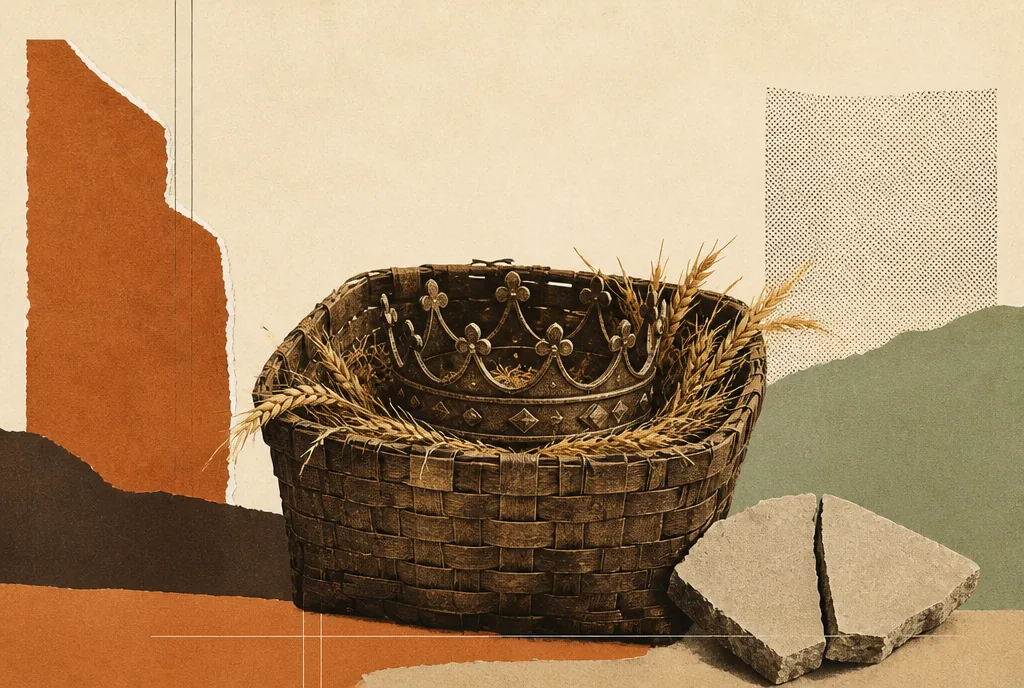
The Moabite is the great-grandmother of the king.
That is the sentence the whole book has been walking toward. Not the wedding. The lineage.
And a thousand years later, when Matthew opens his gospel and lists the ancestors of Jesus, he names her: Boaz the father of Obed by Ruth. She is one of only four women in the list.
How the traditions have handled this
I am not going to pretend the relationship between Deuteronomy 23 and the book of Ruth is simple, or that Christians have agreed on how the law and this narrative fit together. They have not, and there are careful arguments about the scope of the exclusion, about male descendants versus female, and about how the prophets later handle the foreigner who joins herself to the LORD.
What is not in dispute is what the text does. It takes a category the law had excluded and puts a member of that category into the royal line, on purpose, and then tells you so in the last sentence.
Why it matters
There is a way of reading the Bible in which the rules are the point and the stories are illustrations of them.
Ruth resists that. It is a book in which a specific foreign woman’s loyalty, exercised at real cost with no prospect of reward, ends up mattering more to the shape of the story than her nationality did.
If you have ever felt like a category rather than a person — too far outside, too late, from the wrong background, on the wrong side of some line that was drawn before you got here — this is a short book and it is worth an hour.
It was written down, kept, read publicly for centuries, and then quoted at the top of the first gospel.
Four chapters. Read it in one sitting, and read the last three verses slowly.
The passages in this article
Ruth, Deuteronomy 23:3-8, Leviticus 19:9-10, Deuteronomy 24:19-22, Matthew 1:5, Genesis 2:24