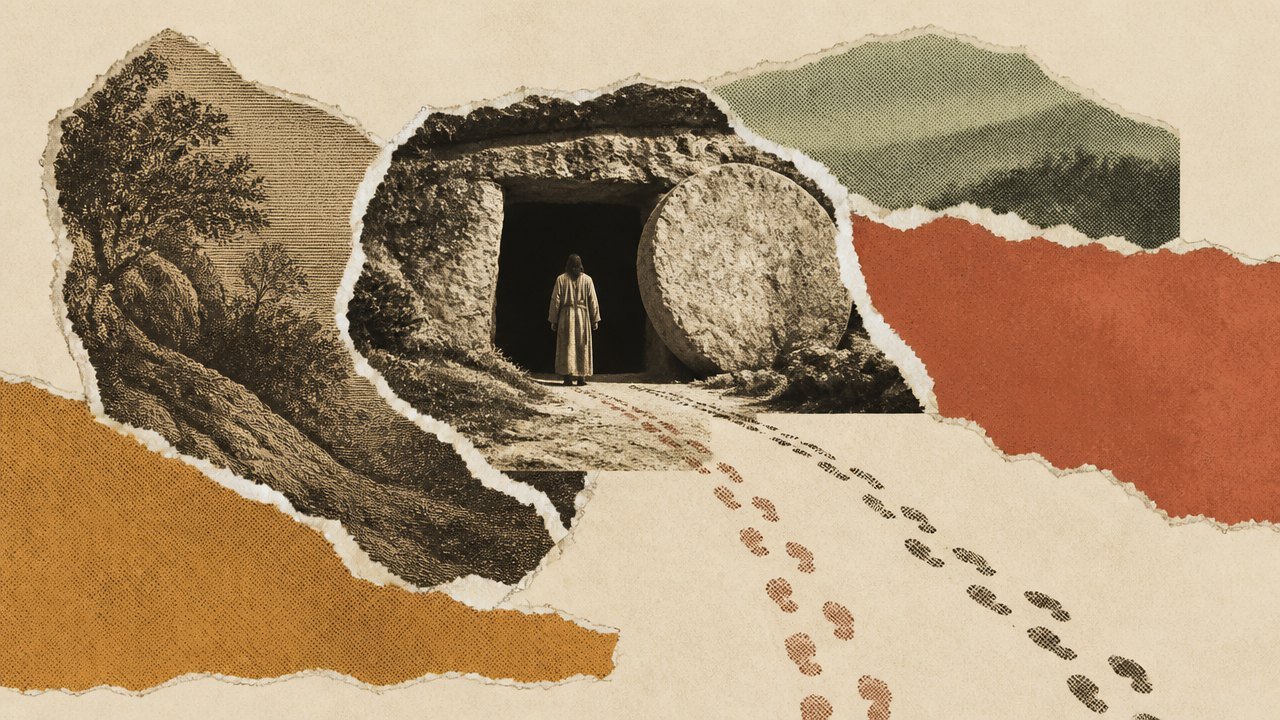
All four gospels put the women at the empty tomb first.
Matthew, Mark, Luke and John differ on a number of details in the resurrection accounts — how many women, which women, what exactly they saw, the order of the appearances. Skeptics have made much of those differences and believers have offered various harmonizations, and I am not going to litigate that here.
But on one point all four agree without variation. The first people to find the tomb empty were women.
Why that is strange
You have probably heard the reason given, and you have probably heard it given too strongly. It is worth getting right, because the honest version of this is still striking and the popular version is not quite true.
Here is what can actually be shown. Josephus, a Jewish writer working within a generation of the gospels, is setting out the law of Moses for a Greek and Roman readership when he writes: let not the testimony of women be admitted, on account of the levity and boldness of their sex. He puts slaves in the same sentence, for a different insult. That is a real first-century Jewish source saying a very blunt thing, and it is where most of this argument properly comes from.
Now the qualifications, which the internet version tends to leave out.
That rule is not in the Torah. Josephus is summarizing, and he is writing to an audience he wants to impress. The rabbinic material people usually reach for is later — the Mishnah was compiled around the year 200 — and it is more complicated than a flat ban. There are categories in which a woman’s evidence was received, and scholars who work on this argue about how much of the later legal picture was already in force in the first century.
So the strong claim — a woman’s testimony was legally inadmissible, full stop — overclaims. If you have repeated it, you were handed it by somebody who believed it; it circulates constantly. But the weaker claim stands, and it is all the argument needs: a woman’s word did not carry a man’s weight in that world, in Jewish and Greco-Roman settings alike, and a witness list headed by women was not a strong witness list.
Which is still a problem for anyone arguing that the resurrection accounts were constructed to persuade.
If you are inventing a story to convince a first-century audience, you do not open with your least impressive witnesses. You put Peter at the tomb. You put John there. You certainly do not have the male disciples hiding behind a locked door while the women go to the grave at dawn.
The accounts do exactly the thing a fabricator would avoid.
What Luke says about the reaction
Luke does not soften it. When the women come back and tell the eleven what they have seen, he writes:
But these words seemed to them an idle tale, and they did not believe them.
The word behind idle tale appears nowhere else in the New Testament. The lexicons gloss it as idle talk, nonsense, twaddle. Luke had gentler options and did not take them.
He also names the women in the verse immediately before — Mary Magdalene, Joanna, Mary the mother of James, and others with them — so this is not a vague dismissal of an anonymous rumor. He tells you who they were and then tells you they were not believed.
That is the first response of the apostles to the first resurrection testimony, and Luke — writing to strengthen the faith of a man named Theophilus — leaves it in. Then in the next sentence Peter runs to the tomb anyway, looks in, and goes home marveling, which is Luke’s honest word for a man who has seen something and does not yet know what it means.
John slows it right down
John gives the most detailed version, and it is worth reading properly.
Mary Magdalene comes while it is still dark. She sees the stone moved and runs to Peter and the other disciple. They race to the tomb, look in, see the linen cloths, and go home.
One small thing in passing. John describes Mary going alone, and then has her say we do not know where they have laid him. The plural slips out. He has not mentioned anyone else, and the other three gospels tell you who the others were.
She stays. Weeping, outside.
Then the exchange that I think is one of the most human things in the New Testament. She turns and sees someone she takes for the gardener, and asks him — asks the man she does not recognize — whether he has moved the body, and if so, where to, because she will go and get it herself.
She is planning to carry a corpse.
And he says her name. Mary.
That is the moment. Not an argument, not evidence, not an empty tomb. Her name, said by someone she thought was staff.
And then she is sent
Jesus said to her, “Go to my brothers and say to them, I am ascending to my Father and your Father, to my God and your God.” Mary Magdalene went and announced to the disciples, “I have seen the Lord.”
The first person commissioned to announce the resurrection is a woman, to the apostles, who do not believe her.
The church has noticed this for a very long time, and it is worth being accurate about how long. Hippolytus, writing in the third century, already describes the women at the tomb as sent to be apostles to the apostles. The fixed Latin title apostolorum apostola is later, and belongs to the medieval West, where it turns up in writers like Abelard and Bernard of Clairvaux. The Christian East has long called her Myrrh-bearer and Equal-to-the-Apostles.
Different languages, different centuries, different communions, reaching for the same idea about the same woman.
The objection that has teeth
There is one honest objection to everything above, and it is not the one skeptics usually lead with.
The earliest written summary of the resurrection we possess is not in a gospel. It is in 1 Corinthians 15, where Paul hands on what he says he received: that Christ died, was buried, was raised on the third day, and that he appeared to Cephas, then to the twelve. Then five hundred. Then James. Then all the apostles. Then Paul himself.
No women. Not one, in a list that runs to six.
If the women-at-the-tomb observation were the whole case, that would be a genuine dent in it, and I would rather say so than pretend it is not there.
What people make of the omission varies, and I am not able to settle it. Some read Paul’s list as a formal roll of official witnesses rather than a full chronology, which would explain who is on it. Others read the omission as evidence that the women’s part was already being smoothed over as the tradition hardened — and if that is right, it makes the gospel writers’ decision to keep it more remarkable rather than less, because they had the smoother version available and did not use it.
Either way, the observation is narrower than it is usually sold. It is a real feature of the four gospel accounts. It is not a proof of the resurrection, and the earliest summary of the resurrection does not contain it.
What I take from it
Two things, and neither is an argument.
The first is about the reliability of the accounts. Not proof — I want to be careful there. Nobody is obliged to believe the resurrection because of a detail about ancient testimony conventions, and I distrust apologetics that overclaim.
But it is a real observation, and it cuts in one direction. The embarrassing detail is preserved in all four sources, including in a gospel explicitly written to build confidence. That is what documents look like when the writers are constrained by what happened rather than free to construct.
The second is more personal. The people who stayed were the people who got there first.
The disciples came, looked, and went home. That is not a slur; they had run there. But Mary stayed outside a tomb she believed still contained a body, with no expectation of anything, doing nothing except being unwilling to leave.
And the encounter happened in the staying.
I would not build a doctrine on that. But I notice it, especially in seasons where I have nothing to bring to God except an unwillingness to go away.
A practice
Read John 20:1-18 slowly, out loud, in one sitting. It takes four minutes.
Watch how much of it happens in the dark, how much of it is misunderstanding, and how late the recognition comes.
Then notice that the whole Christian claim — the thing every tradition confesses in the creed, the reason there is a church at all — is first spoken by a weeping woman who had come to do the last kind thing you can do for a dead friend.
I have seen the Lord.
Nobody believed her either.
The passages in this article