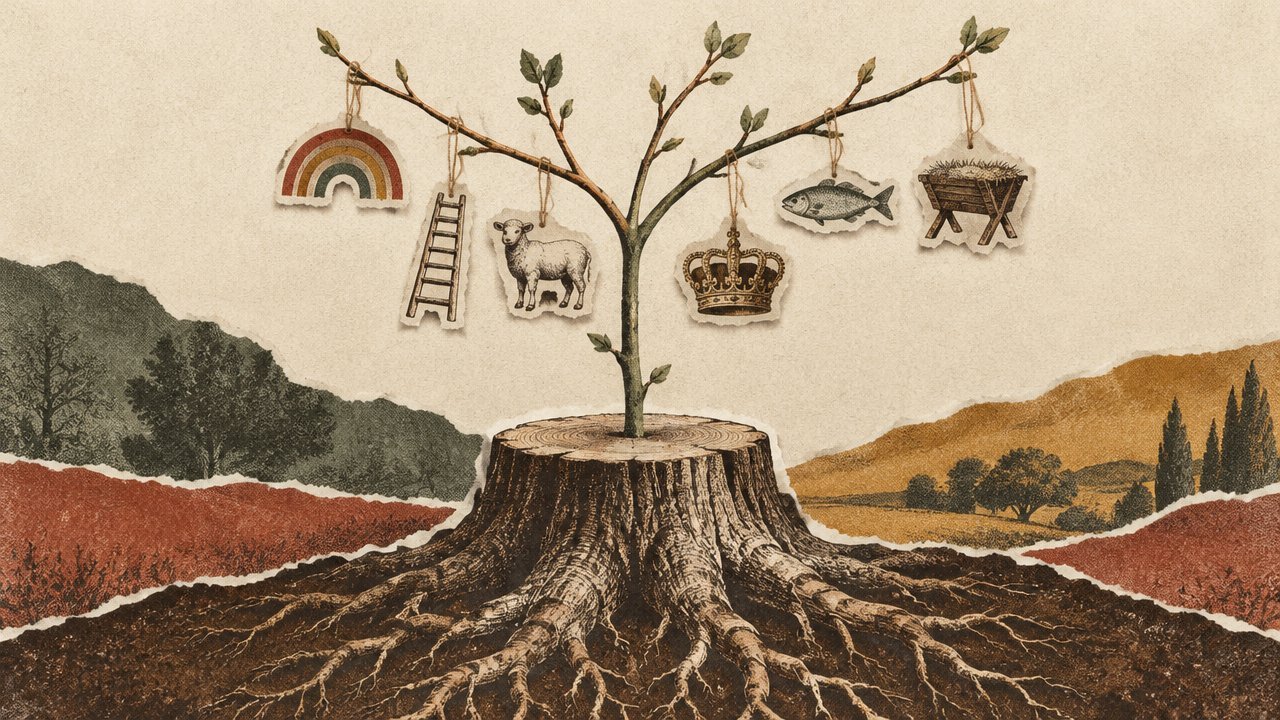
Some families decorate one tree in December. Families who keep a Jesse Tree decorate two, or at least a branch, and the second one fills up slowly. One ornament a day, each with a short reading from Scripture, starting at the beginning of the Bible and ending at the manger.
By Christmas Eve the branch holds the whole long story that Christmas finishes: a garden, a flood, a ladder, a burning bush, a shepherd boy with a horn of oil poured over his head. A child who has hung those ornaments one at a time knows something about Christmas that a child who has only opened the presents does not. Jesus did not arrive out of nowhere. He arrived at the end of a family story that had been unfolding for centuries.
Here is where the custom comes from, how to keep it simply, and a complete list of readings and ornaments for every day of Advent 2026.
Where the name comes from
The Jesse Tree takes its name from a single verse in Isaiah:
There shall come forth a shoot from the stump of Jesse, and a branch from his roots shall bear fruit.
Jesse was the father of King David. By Isaiah’s day, David’s royal line looked less like a tree than a stump: the kingdom was shrinking, and it would later be cut down by Babylon. Isaiah promises that life will come back out of what looks dead. A new shoot will grow from the old root, and Isaiah goes on to describe a king on whom the Spirit of the Lord shall rest, who will judge the poor with righteousness. The New Testament writers saw that promise kept in Jesus, the son of David, as Matthew calls him in the first line of his gospel.
Medieval Christians loved to draw this. The Tree of Jesse became one of the great subjects of medieval art: Jesse lying asleep at the bottom, a vine or tree rising from his body, kings and prophets in its branches, and Christ at the top. One of the most famous is the twelfth-century Jesse window in the west front of Chartres Cathedral.
The household Advent custom, with paper or wooden ornaments and a reading each day, is much newer. It became popular in the twentieth century, especially in North America, and today it is kept by Catholic, Lutheran, Anglican, Reformed, Methodist and evangelical families alike. Because it is built entirely out of Scripture, it fits almost any church.
How to keep it
You need very little:
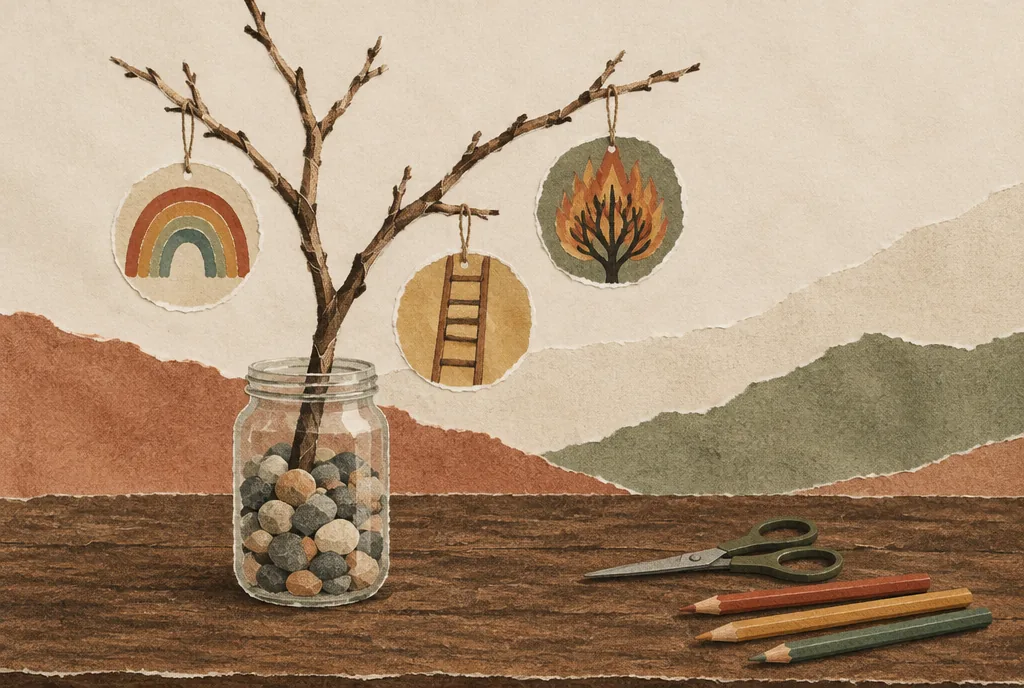
- A tree or branch. A small tabletop tree, a bare branch in a jar of stones, or a tree drawn on poster board and taped to the wall.
- Ornaments. One per day. Paper circles colored by the children work perfectly well. Many families make a set once and reuse it for years.
- A Bible and ten minutes. Most families do it at dinner or bedtime.
Read the passage, talk about it briefly, then let a child hang the ornament. The readings below are short on purpose. With small children, you can read just the key verse and tell the rest of the story in your own words.
There is no single official list. Different books and parishes arrange the figures differently, and some run longer or shorter. The list below follows the most common pattern, from creation to the birth of Jesus, fitted to the 26 days of Advent in 2026.
Week one: the beginning and the promise
- Sunday, November 29 · The stump of Jesse. Isaiah 11:1-10. Ornament: a stump with one green shoot.
- Monday, November 30 · Creation. Genesis 1:1-2:3. Ornament: the sun and moon, or the earth.
- Tuesday, December 1 · Adam and Eve. Genesis 3:1-15. Ornament: a piece of fruit and a serpent.
- Wednesday, December 2 · Noah. Genesis 8:6-22 and 9:8-17. Ornament: a rainbow, or the ark.
- Thursday, December 3 · Abraham. Genesis 15:1-6. Ornament: a sky full of stars.
- Friday, December 4 · Isaac. Genesis 22:1-14. Ornament: a ram caught in a thicket.
- Saturday, December 5 · Jacob. Genesis 28:10-22. Ornament: a ladder.
A note on Tuesday. Genesis never says the fruit was an apple. It says only that the woman took of its fruit and ate. The apple came later, through art. Any fruit will do on the ornament, and a child may enjoy knowing that.
The same chapter holds what Christians have long called the first promise of the gospel. God tells the serpent that the woman’s offspring shall bruise your head, and you shall bruise his heel. The story of the Jesse Tree starts here: with a wound, and a promise that it will not have the last word.
Week two: a family and a people
- Sunday, December 6 · Joseph. Genesis 37:1-11 and 50:15-21. Ornament: a robe of many colors.
- Monday, December 7 · Moses. Exodus 3:1-15. Ornament: a burning bush.
- Tuesday, December 8 · The Passover. Exodus 12:1-14. Ornament: a lamb, or a doorframe.
- Wednesday, December 9 · The Law. Exodus 20:1-17. Ornament: two stone tablets.
- Thursday, December 10 · Joshua. Joshua 6:1-20. Ornament: a ram’s-horn trumpet.
- Friday, December 11 · Ruth. Ruth 1:16-17 and 4:13-17. Ornament: a sheaf of grain.
- Saturday, December 12 · Jesse and the anointing of David. 1 Samuel 16:1-13. Ornament: a horn of oil.
Ruth matters more than her short book suggests. She was a Moabite, a foreigner, and she became the great-grandmother of David. The last verses of her book end with a family tree: Obed fathered Jesse, and Jesse fathered David. Matthew includes her by name in the genealogy of Jesus. We wrote about why Ruth is a book about a foreigner.
Saturday is the day the tree gets its name. Samuel goes to the house of Jesse in Bethlehem looking for a king, and passes over every older brother, because man looks on the outward appearance, but the Lord looks on the heart. The youngest, out with the sheep, is sent for. Then Samuel took the horn of oil and anointed him in the midst of his brothers.

Week three: kings and prophets
- Sunday, December 13 · David the king. 2 Samuel 7:8-16. Ornament: a crown, or a harp.
- Monday, December 14 · Solomon. 1 Kings 8:22-30. Ornament: the temple.
- Tuesday, December 15 · Elijah. 1 Kings 18:30-39. Ornament: fire on an altar.
- Wednesday, December 16 · Isaiah. Isaiah 6:1-8. Ornament: a burning coal held in tongs.
- Thursday, December 17 · Jonah. Jonah 1:17-2:10. Ornament: a great fish.
- Friday, December 18 · Daniel. Daniel 6:10-23. Ornament: a lion.
- Saturday, December 19 · Micah and Bethlehem. Micah 5:2-5. Ornament: a small town on a hill.
Sunday’s reading is the hinge of the whole tree. God promises David, your house and your kingdom shall be made sure forever before me. Your throne shall be established forever. Everything after it, the long line of kings and the prophets who warned them, hangs on that promise. When the kingdom falls, the prophets keep saying that God has not forgotten it.
Micah’s promise is the one the scribes quote to Herod when the wise men come asking where the king is to be born: But you, O Bethlehem Ephrathah, who are too little to be among the clans of Judah, from you shall come forth for me one who is to be ruler in Israel. Too little is the point.
The last days: the ones who were waiting
- Sunday, December 20 · Zechariah and Elizabeth. Luke 1:5-25 and 57-66. Ornament: a writing tablet.
- Monday, December 21 · Mary. Luke 1:26-38. Ornament: a lily, or an angel.
- Tuesday, December 22 · John the Baptist. Luke 1:67-80 and Mark 1:1-8. Ornament: a shell, for baptism.
- Wednesday, December 23 · Joseph of Nazareth. Matthew 1:18-25. Ornament: a carpenter’s square or hammer.
- Thursday, December 24 · The birth of Jesus. Luke 2:1-20. Ornament: a manger.
The writing tablet is a detail children love. Zechariah, struck silent for not believing the angel, cannot speak when his son is born. When the relatives want to name the boy after his father, he asked for a writing tablet and wrote, “His name is John.” His voice comes back at once, and the first thing he does with it is praise God.
The figures in this last week stand at the edge of the story: an elderly priest and his wife, a young woman in Nazareth, a man who has to decide what to do about the woman he is engaged to. Each of them is told something they could not have expected and has to decide whether to trust it.
On Christmas Eve the last ornament goes on the branch. Some families save a star for the top on Christmas morning, and read John 1:1-14: the Word became flesh and dwelt among us.
Why a family tree
There is something quietly bold about the Jesse Tree. It takes a season that our culture fills with novelty and fills it instead with old stories, many of them uncomfortable. A flood. A father told to sacrifice his son. A brother sold into slavery. A prophet who ran the other way.
That is the family Jesus was born into. Matthew opens his gospel with the genealogy, and it is not a tidy one. We wrote about the genealogy nobody reads and why it matters that Matthew included the names he did.
A child who hangs those ornaments learns that God works through long stories, through families that are far from perfect, and through promises that take generations to keep. Most of us, at any age, need to learn that again in December.
If you would rather read two short passages a day with an Old Testament promise paired to its New Testament fulfillment, our Advent 2026 reading plan follows the same story in the spirit of the Jesse Tree, with a printable checklist.
The passages in this article
Isaiah 11:1-10, Genesis 3:1-15, Genesis 15:1-6, Genesis 22:1-14, Genesis 28:10-22, Exodus 3:1-15, Ruth 4:13-22, 1 Samuel 16:1-13, 2 Samuel 7:8-16, Micah 5:2-5, Luke 1:5-25, Luke 1:57-66, Matthew 1:18-25, Luke 2:1-20