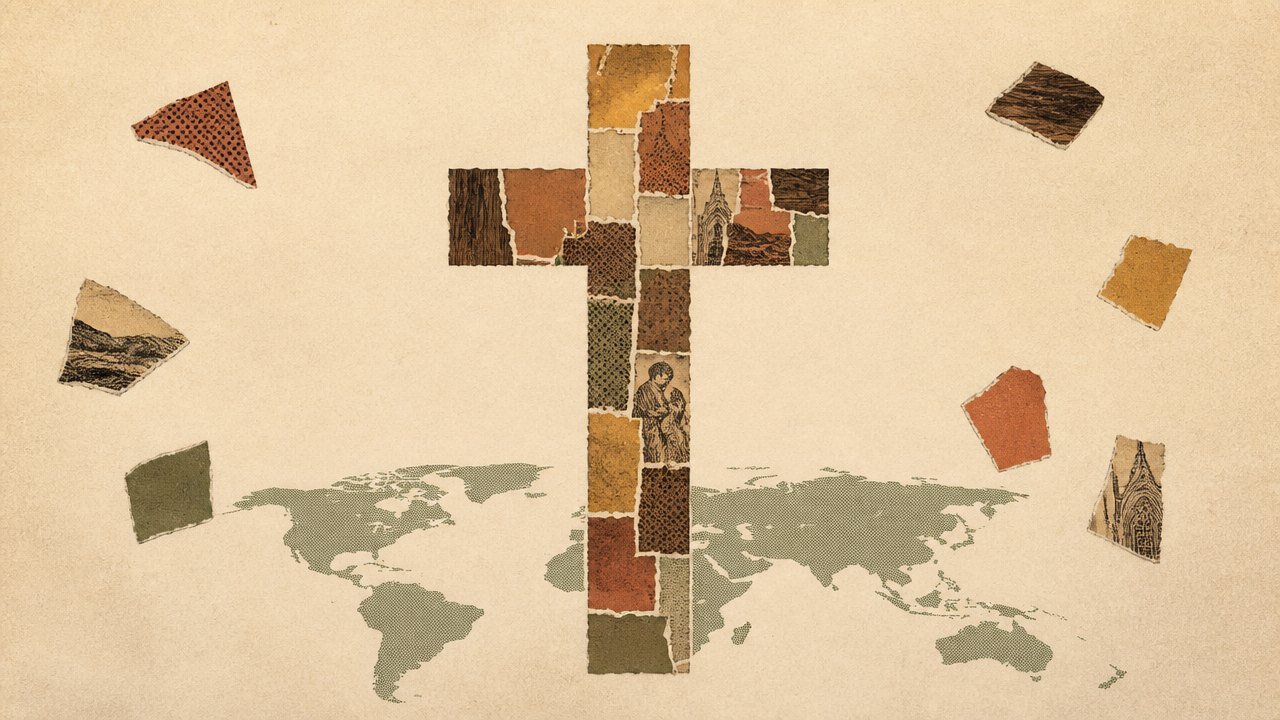
Every Sunday, in an enormous number of churches, people stand up and say they believe in one holy catholic and apostolic Church, rarely stopping to ask what does catholic mean.
And in a fair number of those churches, a percentage of the congregation feels a small hesitation on the third word.
Some hymnals print a lowercase c and add a footnote. Some print christian instead. Some ministers explain it briefly before the creed every single week, which tells you how often people ask.
The hesitation is understandable. But it rests on a mistake about the word itself, and the history is genuinely interesting — and, I think, genuinely encouraging.
An ordinary Greek word
Catholic comes from the Greek adjective katholikos, which comes from the phrase kath’ holou — kata, “throughout” or “according to,” plus holos, “whole.”
Throughout the whole. On the whole. In general.
That is all it means. And it was not a religious word. It shows up in Aristotle and in Polybius doing perfectly ordinary work, in contexts with nothing to do with God. In philosophical usage its natural opposite is merikos — partial — or idios — particular, one’s own.
So the closest English feel is something like our word general. A general practitioner. A general store. General, as opposed to specialized, partial, or private.
That is the word the creed uses about the Church.
The first Christian to write it down
The earliest surviving Christian use of the phrase is in a letter from Ignatius, bishop of Antioch, written in the early second century while he was being taken under guard to Rome to die. Writing to the church at Smyrna, he says:
Wherever the bishop shall appear, there let the multitude be; even as, wherever Jesus Christ is, there is the catholic Church.
Here is the detail I keep coming back to. He does not stop to define it.
He drops katholikē into a sentence the way you would drop any ordinary adjective, with no explanation, in a letter to people he expects to understand him immediately. Which means the usage was already current. By the time it first appears in writing, it was already old enough to need no gloss.
We are, in other words, reading a word that Christians were already using before anyone thought to write it down.
What the creed is claiming
If the word means throughout the whole, then the creed is not making a claim about size, or headquarters, or administration. It is making a claim about wholeness in at least two directions.
Everywhere. Ignatius is writing from prison in one province to a congregation in another, and he takes for granted that they are the same thing. Not a franchise. The same Church, whole in each place.
Everything. Katholikos against merikos — whole against partial. The Church confesses the entire faith, not the parts of it that suit a particular temperament, era, or nation. Cyril of Jerusalem, teaching new Christians in the fourth century, works straight down this list. The Church is called catholic, he says, because it extends over all the world; because it teaches completely every doctrine that ought to come to human knowledge; because it brings the whole race of mankind, governors and governed, learned and unlearned, into subjection to godliness; and because it treats and heals every kind of sin. Note what is doing the work in every clause. Not how many. How much of.
Both senses are humbling before they are triumphant. To say catholic is to admit that what you hold is not your own private version of Christianity.
The part where I stop
At some point the word also became a proper name. It came to identify one particular communion, and English speakers now hear that meaning first, which is why the hesitation in the creed happens at all.
Whether that communion is rightly the catholic Church, in the creed’s sense, is one of the oldest and most serious disagreements among Christians. It is a real question. People far more learned and far holier than me have given their lives to it on more than one side.
It is not the question of this article, and I am not going to pretend to settle in a thousand words what has not been settled in a thousand years. If you came here hoping I would take a side, I would rather disappoint you than be glib about something that has cost people so much.
What I want to say instead is narrower, and I think everyone can hold it: the word in the creed is older than the dispute, and it means what it has always meant.
Why the substitutions do not quite work
When a hymnal prints christian in place of catholic, it is usually an act of translation rather than denial. The editors are trying to convey to a modern congregation what the word originally conveyed, without the proper-noun confusion. That is a defensible instinct and I have no quarrel with anyone who does it.
But something is lost, and it is worth naming.
Christian tells you whose the Church is. Catholic tells you how much of it there is, and how much of the faith it holds. They are not the same claim. The creed already said the Church — adding christian is close to saying it twice. Adding catholic says something new.
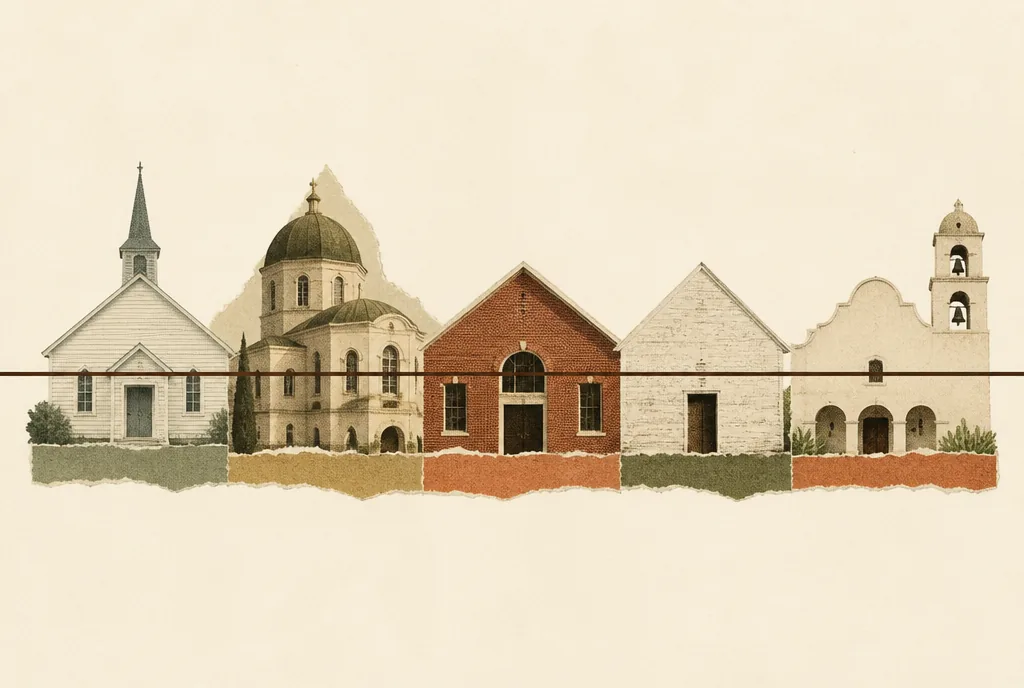
And the word is a bridge. It is one of the very few things that Orthodox, Roman Catholic, Anglican, Lutheran, Presbyterian, Methodist and a great many other Christians say out loud, in the same order, most weeks, in a text older than every one of those names. Retiring it costs more than it saves.
Living as though it were true
Here is where this stops being word history.
If catholic means whole, then it functions as a quiet test on the way I actually hold my faith. Two questions I have found useful, and neither of them requires me to leave where I am:
Would a Christian from a thousand years ago recognize what I believe? Not the furniture — the music, the building, the language. Underneath that. If everything I hold dear was invented within my own lifetime or my own country, something has gone merikos. Partial.
Is what I believe available to people unlike me? The catholic claim is that this faith is for the whole world, not for a temperament, a class, or a demographic. If my version of Christianity would be unintelligible to someone poor, or elderly, or from another continent, that is worth sitting with.
Neither question asks you to change communions. Both ask whether you are holding a whole thing or a slice of one.
The word in your mouth
So the next time you come to that line and feel the small hesitation — and if you have felt it, you are in enormous company — you might try this.
Say it slowly, and hear the old meaning underneath the modern one. One — not many rival gospels. Holy — set apart, and not by our doing. Catholic — whole, everywhere, for everyone, all of it. Apostolic — going back to the men who were actually there.
It is a large sentence. It has been said by martyrs, by farmers, by frightened people, by bored people, in more languages than anyone can count, for well over a thousand years before any of us arrived.
And it was, first and last, an ordinary word that means the whole thing. There is something fitting about that. The most contested word in the creed turns out to be the most generous one.