
It is one of the first questions a thoughtful child asks about the four gospels, and one of the last a thoughtful adult stops asking.
Four accounts of the same life. They do not line up. The order of events differs. The wording of famous sayings differs. Matthew and Luke give genealogies that do not match. The resurrection accounts name different women arriving at the tomb and different numbers of figures waiting there.
Skeptics reach for this as an argument. Believers, quite often, reach for a harmony — a chart, an appendix, a careful explanation of how it all fits.
I want to suggest something that took me a long time to arrive at: the fourfold shape is not damage. It is a decision. And the gospels themselves say so, in their own words, before anyone outside them ever weighed in.
Luke tells you there are others
The third gospel opens not with angels or genealogy but with a paragraph of housekeeping addressed to one man:
Inasmuch as many have undertaken to compile a narrative of the things that have been accomplished among us, just as those who from the beginning were eyewitnesses and ministers of the word have delivered them to us, it seemed good to me also, having followed all things closely for some time past, to write an orderly account for you, most excellent Theophilus, that you may have certainty concerning the things you have been taught.
Sit with what Luke has just admitted.
He knows he is not first. Many have already undertaken this. He does not say they were wrong, or heretical, or that he is writing to replace them. He says he has investigated carefully and is now writing an orderly account for a particular reader, for a particular purpose.
The New Testament’s longest single author opens by acknowledging plurality and does not apologize for it.
And notice the goal he names: that you may have certainty concerning the things you have been taught. Luke is not writing to a doubter. He is writing to someone who has already been taught, so that what he was taught might rest on something firmer.
John tells you he is selecting
John is even more direct:
Now Jesus did many other signs in the presence of the disciples, which are not written in this book; but these are written so that you may believe that Jesus is the Christ, the Son of God, and that by believing you may have life in his name.
That is a stated editorial policy. There was more. He chose. He tells you what he chose for.
And then, in the last verse of the gospel, with what I have always read as a slight smile:
Now there are also many other things that Jesus did. Were every one of them to be written, I suppose that the world itself could not contain the books that would be written.
So two of the four evangelists tell us plainly that they are working with selection and arrangement. Neither one claims to be a transcript. Neither one seems to think that admitting this weakens anything.
We are the ones who assumed they were claiming otherwise.
Somebody did try to merge them
In the 160s, a Christian named Tatian did exactly what many modern readers instinctively want to do. He wove the four gospels into a single continuous narrative — the Diatessaron, from the Greek for “through four.”
It was not a fringe project. It became the standard gospel text in the liturgy of at least parts of the Syriac-speaking church, and it held that place for something like three centuries.
And then it was set aside, and the four separate gospels took its place.
I find that history remarkable. The harmony existed. It was in use, in real churches, for generations. It was the more convenient book. And the Church — which had every practical reason to keep a single tidy narrative — went back to the four that disagree.
That was not carelessness. Somebody thought the four were worth the difficulty.

Irenaeus, and being honest about his argument
Around 180, Irenaeus of Lyons wrote the earliest surviving defense of the number:
It is not possible that the Gospels can be either more or fewer in number than they are.
His reasoning is that there are four zones of the world and four principal winds; the Church is scattered through all the world, so it is fitting she should have four pillars. He runs the same pattern through the four faces of the cherubim and through what he calls four principal covenants — under Adam, under Noah, under Moses, and the one that renovates man through the Gospel.
Let me be straightforward. That is not an argument that would persuade anyone today, and I am not going to dress it up as one. It reads exactly like what it is: a man reaching for cosmic symmetry to explain something he has already received.
But that is precisely why it is useful evidence.
Irenaeus is not arguing four gospels into existence. He is defending a number that is already fixed — against people in his own time who wanted fewer, or different ones. By 180, in Gaul, four was simply the fact on the ground, solid enough that it needed a theory rather than a decision. That tells us more about how early the fourfold gospel settled than his four winds ever could.
What the differences actually do
Here is the part worth dwelling on, because it is where the whole question turns from a problem into a gift.
Read Mark and you get urgency. Things happen immediately, over and over; the sentences are short; a man moves through Galilee at speed and the disciples cannot keep up.
Read Matthew and you are constantly being shown a door back into the Hebrew Scriptures — this took place to fulfill what was spoken — a gospel arranged around great blocks of teaching, written for readers who know their Bible.
Read Luke and you notice who keeps appearing in the frame: the poor, women, Samaritans, a tax collector up a tree, a shepherd, a thief. Luke keeps the camera on the people the story could have left out.
Read John and the pace changes entirely. Long conversations. Deliberate, patterned language. Light, water, bread, life.
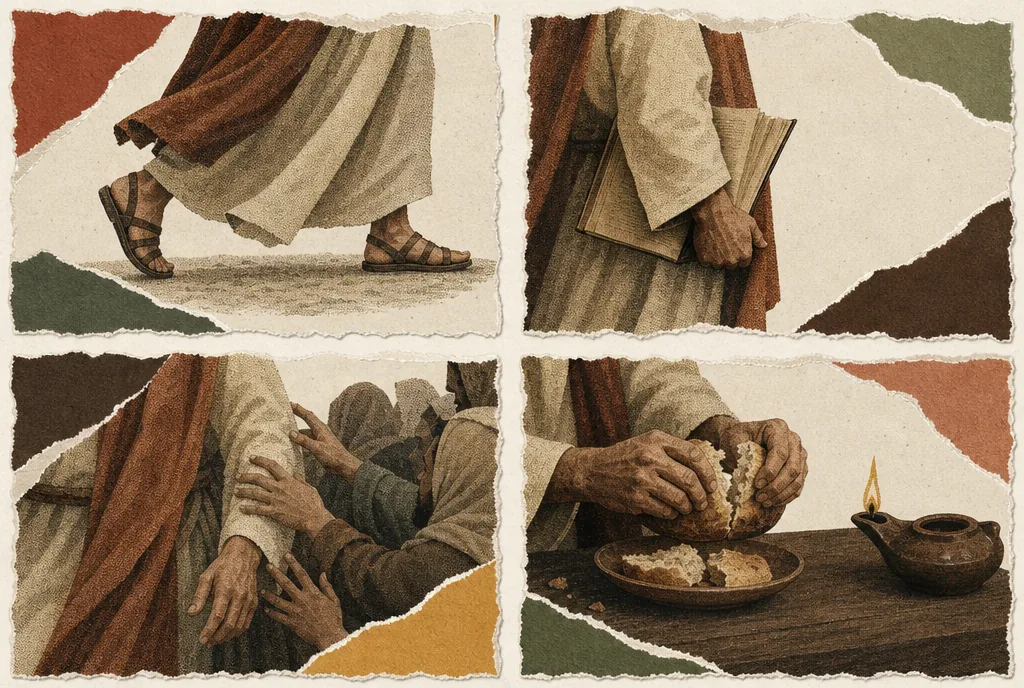
Four portraits, not four photographs. Anyone who has been loved by more than one person knows that different people who love you truly would describe you differently, and that no single description would be more accurate than the four laid side by side.
Tatian’s harmony had to flatten that. Every merge does. To combine four accounts into one you must decide, at every point of difference, which voice wins — and the losing detail simply disappears. The four preserved separately preserve everything.
The kind of certainty on offer
I think the honest thing to admit is that many of us want a different kind of certainty than the one we were given.
We would like a single unanimous account, ideally notarized. Four witnesses who agree in every particular. What we have instead is four accounts that agree overwhelmingly on the substance and vary in the details — which is, as any judge will tell you, what real testimony looks like. Four witnesses whose statements match word for word are not evidence of truth. They are evidence of collusion.
Luke says he wrote so that Theophilus may have certainty. He wrote that sentence knowing full well that many others had written, and that his account and theirs would sit alongside each other, and he still used the word certainty.
So he meant a kind of certainty that survives having four of them.
If the differences trouble you
They trouble a great many faithful people, and it is not a sign of weak faith to notice them. It is a sign of reading carefully, which is generally how God has treated people who bother.
But you might try turning the discomfort around.
Someone, very early, held four accounts in their hands and knew perfectly well that they did not perfectly align. That person could have chosen one. Could have kept the harmony. Could have quietly filed the edges off. Instead they handed all four forward, differences and all, to us.
That is not the behavior of people managing a story.
That is the behavior of people who had received something they did not feel free to tidy.
The passages in this article